Ah, and it's a fine graupelly morning.
When did they change the spelling from "grapple" to "graupel"? Damned froggy of them, if you ask me.
Wednesday, February 22, 2006
Jessica, you were talking about gold few weeks back. What do you think of this article? I know what I think on the subject, but I'm generally biased against the whole gold-bug notion, so I suppose I'm not the most objective of voices where gold is concerned. I like the idea that the increasing wealth of the Indian & Chinese consumer is buying up the price of jewelry.
There is some heavy shit going down around the world. I won't belabor the potential ugliness of the Samarra Shi'ite shrine bombing, because it's all over Rantburg and the rest of the blogsphere, and because it's so clearly a situation on the verge of a full-blown pogrom. But this bit from Michael Ledeen about the riots in Benghazi is something I had *not* noticed, and illustrates just how much gets covered up & ignored when emotion & knee-jerk reaction filters the news, on the right as well as the left.
Those Benghazi riots, with more than a dozen dead, got reported as just another particularly violent set of protests in the wave of anti-Danish-cartoon violence. But Ledeen's emailer suggests that A) it actually had more to do with a calculated anti-Italian move by the Libyan government and B) the actual violence occurred after the authorities lost control of their rent-a-mob and it turned into a nasty anti-regime riot bordering on an uprising. Ledeen & his emailer make it sound like a mini-Hama in the offing, which would be deeply, deeply ugly if it's the case.
Those Benghazi riots, with more than a dozen dead, got reported as just another particularly violent set of protests in the wave of anti-Danish-cartoon violence. But Ledeen's emailer suggests that A) it actually had more to do with a calculated anti-Italian move by the Libyan government and B) the actual violence occurred after the authorities lost control of their rent-a-mob and it turned into a nasty anti-regime riot bordering on an uprising. Ledeen & his emailer make it sound like a mini-Hama in the offing, which would be deeply, deeply ugly if it's the case.
Gah! I innocently enter "Genesis" into an EPA label lookup engine, and get buried under with sixty instances from a company named "Frank Miller & Sons". Rat bait, herbicide, weedkiller, insecticide, algicide - they've named every single blamed thing they sell "Genesis"! It's like George Foreman & his multiple sons George, except the Foreman family isn't running an inventory system with their boys' names!
There's an insecticide needle in here somewhere... ahah! Found it! The one Bayer CropScience 'un in the haystack.
There's an insecticide needle in here somewhere... ahah! Found it! The one Bayer CropScience 'un in the haystack.
Mind-warper for the day: Eric S. Raymond's essay on the legacy of Stalinist memetic warfare. Essentially, he's re-imagined the post-Marxist/transnational progressivist intellectual hangover as a species of pollution - the imaginative equivalent of buried nukes or bioweapons contaminating intellectual groundwaters. Hell, on a small scale, those WWI-era shells French farmers still keep getting blown up by now and again in the fields of the Somme or Meuse. He calls this poisoning by abandoned, unguided Stalinist intellectual warfare Gramscian damage.
Raymond:
I've always called it "the monster in your mind" when I've encountered this societal rage in others, although usually not to their face. But Raymond seems to be making a case for the intellectual equivalent of environmental poisoning: not ideological vampirism, but Stalinist lead poisoning, the product of a stunting of a person's moral and intellectual growth at a vulnerable age.
Raymond doesn't stop with that idea. He goes on:
He worries that the replacement which fills in the space left by the termination of the "suicidalist" ideology will be a monster, less likely a jihadist caliphate than a radicalized, hateful European-style fascism, bitter from repeated terror-nukings:
I recognize this is over-quoting, but I love that last sentence with a pure and platonic ardour.
Via Instapundit this morning.
Raymond:
The first step to recovery is understanding the problem. Knowing that suicidalist memes were launched at us as war weapons by the espionage apparatus of the most evil despotism in human history is in itself liberating.
I've always called it "the monster in your mind" when I've encountered this societal rage in others, although usually not to their face. But Raymond seems to be making a case for the intellectual equivalent of environmental poisoning: not ideological vampirism, but Stalinist lead poisoning, the product of a stunting of a person's moral and intellectual growth at a vulnerable age.
Raymond doesn't stop with that idea. He goes on:
Again, this is by design. Lenin and Stalin wanted classical-liberal individualism replaced with something less able to resist totalitarianism, not more. Volk-Marxist fantasy and postmodern nihilism served their purposes; the emergence of an adhesive counter-ideology would not have. Thus, the Chomskys and Moores and Fisks are running a program carefully designed to dead-end at nothing.
He worries that the replacement which fills in the space left by the termination of the "suicidalist" ideology will be a monster, less likely a jihadist caliphate than a radicalized, hateful European-style fascism, bitter from repeated terror-nukings:
The U.S., fortunately, is still on a demographic expansion wave and will be till at least 2050. But if the Islamists achieve their dream of nuking "“crusader" cities, they'’ll make crusaders out of the U.S., too. And this time, a West with a chauvinized America at its head would smite the Saracen with weapons that would destroy entire populations and fuse Mecca into glass. The horror of our victory would echo for a thousand years.
I recognize this is over-quoting, but I love that last sentence with a pure and platonic ardour.
Via Instapundit this morning.
Monday, February 20, 2006
Played poker most of the weekend. Saturday was kind of odd. The host's schoolteacher-in-training fiancee was playing Spanish-language Taboo with her friends, and it degenerated into what the host said was a mix of a political argument and really fithy girl-talk. Still, it was a better night than Friday, when the host was pouring gallons of beer & a concoction made mostly out of apple rum into everyone, and half the table was falling-down drunk. I was the most sober player at the table, and I *still* lost my shirt. I think maybe I ought to dial it back a bit - I'm losing more than is good for my continued sunny disposition.
Speaking of sun or the notable lack thereof, how about those wild temperature swings? Cold as heck last night; even my mother down in Florida was complaining about how cold it has gotten. Betcha the Canadian High Plains are baking again, though - seems to this winter's pattern, with the High Plains & the East swapping warm and frigid air masses back and forth.
Speaking of sun or the notable lack thereof, how about those wild temperature swings? Cold as heck last night; even my mother down in Florida was complaining about how cold it has gotten. Betcha the Canadian High Plains are baking again, though - seems to this winter's pattern, with the High Plains & the East swapping warm and frigid air masses back and forth.
Friday, February 17, 2006
Check out this mindwarping taxonomy of American libertarian trends using, apparently, Fischer's subcultural tropes from Albion's Seed. I have *got* to read that book.
Wednesday, February 15, 2006
Hey, Fred, I was wrong - we hadn't been completely thrown out of that Uzbekistan airbase. They're still straggling on out, over six months after we were given our walking papers.
I've been spending a lot of time watching my old anime DVDs & some borrowed DVDs, including the old Bubblegum Crisis OAVs, so I put in my Bubblegum Crisis 2040 videotapes last night on a whim. Watching the old, "classic" OAVs in rapid succession with the 2040 TV series, I can't imagine why people prefer the OAVs. In writing, animation, plotting, and pacing, the TV series is far, far superior. Admittedly, the plotting, pacing, and writing does a severe drop-off about two-thirds of the way through the series, and it really is a classic "Chiaki Konaka joint", complete with butch female protagonists, yuri-ai undertones, and gloomy, dark overtones of ambiguity & morally dubious motivation; even given all that, I still have a special fondness for the TV series that I just can't muster for the original.
Monday, February 13, 2006
And in the end, what do I think of Griffith's Battle Tactics? He's clearly an infantry specialist - the vast majority of the book is on infantry tactics, infantry battle, and how the other services or branches affect the infantry. He doesn't even so much as quote a contemporary tactics manual for either the cavalry or the artillery. So, I suppose it's almost predictable that his natural inclination is to blame a third supporting branch for what went wrong with the infantry in the Civil War - the engineers.
And I guess I'm somewhat sympathetic to this inclination - I want to indulge in contempt for the engineers - the Popes and McClellans and Rosecranses and Lees and Hallecks whose elitist misfires ought to be to blame for the slaughter and the stalemates. But the time-lines don't favor his arguments about the usage of entrenchment as much as Griffith'd like you to think - and his rather slap-dash binary division of early-war and late-war only partially hides the basic problem with the analysis which blames the Mahanists for the failure of the offensive in the war.
That problem is that the war isn't properly dividable in a binary fashion between the early war of fluid straight-up battle and the later war of positions and sidle-by-the-flanks. Rather, the timeline lends itself more clearly to a trinary division - an early-war reliance on Mahanist prepatory entrenchment on the Lee and McClellan and Halleck model, followed by a post-Seven-Days devolution into open-field butchery, then a bottom-up reversion to form & the introduction of a mature, integral, truly tactical system of entrenchment, starting in fits and starts among the troops during the Chancellorsville and Tullahoma campaigns, through Culp's Hill and Chickamauga and Mine's Run, and adopted near-universally in the parallel 1864 overland campaigns.
Thus, this new introduction of entrenchment was not a theoretical child of the Mahanist school, but rather an echo of the discredited corpse of Mahanist theory, cobbled together as a battlefield invention of desperation & the survival instinct. Obviously, I'm getting a lot of this from Hess's first volume on field fortifications, and I'm now greatly looking forward to the other two projected volumes, regardless of Hess's over-reliance on extraneous narrative.
Most of my other responses to Griffith are mere echoes of what I thought when I first encountered Nosworthy's re-formulation of Griffith's ideas - that the psychological quality of the bayonet as a shock weapon is a valid and interesting idea, but that to also denigrate the psychological value of entrenchment as a counter-tactic to the weapons of shock is a damned double standard; that an increase in range of half again or even double, is no improvement to be spat upon, and that Griffith's own figures take a great deal away from his would-be anti-rifle-musket revisionism; and that almost nobody is giving as much attention to the Petersburg siege battles as I suspect is necessary to properly develop the role of entrenchment and riflery in tactics.
If anyone has any suggestions for books on the Petersburg siege & the tactics thereof, I would be greatly appreciative. I know that there's that book on the ANV sharpshooters corps, and I'll probably have to read it, even though it seems to give off that "Victorious [Confederate] Arms" odor which is so familiar from WWII petty historiography. I have hopes for the second volume of Hess's work on field fortification, too.
And I guess I'm somewhat sympathetic to this inclination - I want to indulge in contempt for the engineers - the Popes and McClellans and Rosecranses and Lees and Hallecks whose elitist misfires ought to be to blame for the slaughter and the stalemates. But the time-lines don't favor his arguments about the usage of entrenchment as much as Griffith'd like you to think - and his rather slap-dash binary division of early-war and late-war only partially hides the basic problem with the analysis which blames the Mahanists for the failure of the offensive in the war.
That problem is that the war isn't properly dividable in a binary fashion between the early war of fluid straight-up battle and the later war of positions and sidle-by-the-flanks. Rather, the timeline lends itself more clearly to a trinary division - an early-war reliance on Mahanist prepatory entrenchment on the Lee and McClellan and Halleck model, followed by a post-Seven-Days devolution into open-field butchery, then a bottom-up reversion to form & the introduction of a mature, integral, truly tactical system of entrenchment, starting in fits and starts among the troops during the Chancellorsville and Tullahoma campaigns, through Culp's Hill and Chickamauga and Mine's Run, and adopted near-universally in the parallel 1864 overland campaigns.
Thus, this new introduction of entrenchment was not a theoretical child of the Mahanist school, but rather an echo of the discredited corpse of Mahanist theory, cobbled together as a battlefield invention of desperation & the survival instinct. Obviously, I'm getting a lot of this from Hess's first volume on field fortifications, and I'm now greatly looking forward to the other two projected volumes, regardless of Hess's over-reliance on extraneous narrative.
Most of my other responses to Griffith are mere echoes of what I thought when I first encountered Nosworthy's re-formulation of Griffith's ideas - that the psychological quality of the bayonet as a shock weapon is a valid and interesting idea, but that to also denigrate the psychological value of entrenchment as a counter-tactic to the weapons of shock is a damned double standard; that an increase in range of half again or even double, is no improvement to be spat upon, and that Griffith's own figures take a great deal away from his would-be anti-rifle-musket revisionism; and that almost nobody is giving as much attention to the Petersburg siege battles as I suspect is necessary to properly develop the role of entrenchment and riflery in tactics.
If anyone has any suggestions for books on the Petersburg siege & the tactics thereof, I would be greatly appreciative. I know that there's that book on the ANV sharpshooters corps, and I'll probably have to read it, even though it seems to give off that "Victorious [Confederate] Arms" odor which is so familiar from WWII petty historiography. I have hopes for the second volume of Hess's work on field fortification, too.
Went out to see a local blues band called "AAA" or "Triple A" play at Zeno's with Fred & some of his friends. The band was pretty good, and I wasted some dosh on a few pints. They have lambic on tap at Zeno's, which is great & all, but good lord is it expensive. The Woodchuck is almost reasonable, though. I was commenting that the lead singer/guitarist of the band sounded kind of like Randy Newman, and then another singer came up to the microphone and launched into Louisiana 1927, which made me laugh. Believe it or not, but it was the first time I had heard it actually played, and not just quoted as lyrics in a blog or livejournal for political points.
I ended up being a Civil War bore at the table, talking about Harsh & the Maryland campaign with a friend of Fred's, a fiddler & science teacher named Andy. We got on the subject because I had a library copy of Griffith's Battle Tactics, and I started in on the whole Jamieson/McWhiney-Griffith-Nosworthy thesis-antithesis-synthesis dialectic. After having finished Griffith over the weekend, I've come to the conclusion that I was being too harsh on him, mostly due to my having encountered all of his ideas in one form or another in Nosworthy, in the wrong chronological order, as it were. I imagine I'll be equally, and equally unfairly, hard on Freeman when I get around to reading more than a few pages here & there of his Lee biography or Lee's Lieutenants, having read Nolan & Connelly & Wert taking apart poor Freeman in books printed in the last thirty years, with all the advantages of hindsight & new research.
I ended up being a Civil War bore at the table, talking about Harsh & the Maryland campaign with a friend of Fred's, a fiddler & science teacher named Andy. We got on the subject because I had a library copy of Griffith's Battle Tactics, and I started in on the whole Jamieson/McWhiney-Griffith-Nosworthy thesis-antithesis-synthesis dialectic. After having finished Griffith over the weekend, I've come to the conclusion that I was being too harsh on him, mostly due to my having encountered all of his ideas in one form or another in Nosworthy, in the wrong chronological order, as it were. I imagine I'll be equally, and equally unfairly, hard on Freeman when I get around to reading more than a few pages here & there of his Lee biography or Lee's Lieutenants, having read Nolan & Connelly & Wert taking apart poor Freeman in books printed in the last thirty years, with all the advantages of hindsight & new research.
Friday, February 10, 2006
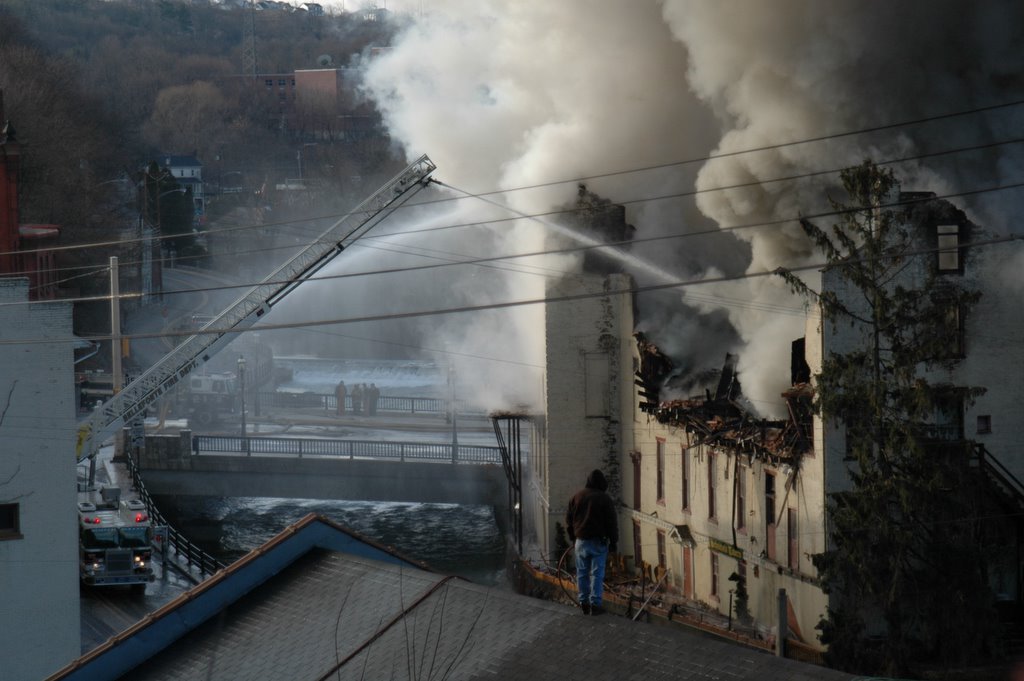
Went down to look at the rubble yesterday evening. Who would have thought the old man had so much brick in him? A two-stories-tall pile of broken wood and tumbled brick, with iron frames sticking up out of the pile where the interior had been reinforced around archways. The pile was still on fire in two separate places below the surface of the rubble, and the whole town smelt of old-wood smoke.
It was still smoking this morning as I made my way out of town.
It was still smoking this morning as I made my way out of town.
Thursday, February 09, 2006
Dimitri noticed my meandering about Griffith, and comments that he reads Griffith as he would a fellow blogger or essayist - presumably for unique viewpoint rather than strict scholarship? I suppose that could work, but I had seen Griffith cited as a specialist, not an advocate. Ironically enough, Jamieson & McWhiney, who *are* cited as advocates for Attack and Die, are somewhat more restrained in their rhetoric, laying aside that book's last third-worth of peculiar racial theorizing.
I suppose I'm saying that I didn't expect Griffith to come across as this much of an... autodidactic crank. Eh, maybe it's the exaggeration of unmet expectations at work.
I suppose I'm saying that I didn't expect Griffith to come across as this much of an... autodidactic crank. Eh, maybe it's the exaggeration of unmet expectations at work.
I'm not coming away from Battle Tactics of the Civil War with a greatly enhanced impression of Paddy Griffith. His basic campaign analysis is exceedingly naive, in a rather Centennial style, and he's building a number of his arguments on those naive judgments. I just hit his section about West Point's origin as a French-style engineering academy, and suddenly there's this violent anti-French-engineer outburst spilling out all over the page. He seems to think that Jomini is in opposition to the French military conservative trend, whereas Nosworthy was insisting that Jomini represents a reactionary re-interpretation of the "Napoleonic" military revolution, a re-arrangement of the mobility and offense-oriented reforms of the late eighteenth century into a modern version of the old posts-and-depots system with a hipper rap.
Gah, now I've gone and confused myself. But nothing Griffith is saying about Dennis Hart Mahan matches what everyone else says about him, nor does it match what little I've read of Mahan himself. Griffith seems to think that Mahan is aping the French engineers, whereas everyone else (especially Hess!) says that Mahan's entrenchment mentality was an indigenous American response to large, unpopulated backcountry & American manpower-shortages.
Gah, now I've gone and confused myself. But nothing Griffith is saying about Dennis Hart Mahan matches what everyone else says about him, nor does it match what little I've read of Mahan himself. Griffith seems to think that Mahan is aping the French engineers, whereas everyone else (especially Hess!) says that Mahan's entrenchment mentality was an indigenous American response to large, unpopulated backcountry & American manpower-shortages.
Ugh. I haven't figured out how to properly hide the cuts, or only invoke them when I want them invoked. As a stop-gap, those little plus signs are the minimum footprint I can leave & still have the show/hide feature working. Yes, I suck at html - this surprises you how?
The rubble was still smoking this morning as I left town, BTW - at least they cleared the intersection of Water & High Street on the southeast side, enough to allow through traffic via the Rt. 144 bypass through town.
The rubble was still smoking this morning as I left town, BTW - at least they cleared the intersection of Water & High Street on the southeast side, enough to allow through traffic via the Rt. 144 bypass through town.
Wednesday, February 08, 2006
Hmm. Now that I've sort-of figured out this posting photos thing, I'm thinking about borrowing somebody's digital camera & doing some architecture-blogging. Maybe next week. There's a lot of cool stuff around town I haven't really dwelt on here, because I was a technical idiot in the photography department.
It'd be nice to get some images of the neat old buildings scattered around town. You know, *before* they burn to the ground from faulty wiring or petty arson.
It'd be nice to get some images of the neat old buildings scattered around town. You know, *before* they burn to the ground from faulty wiring or petty arson.


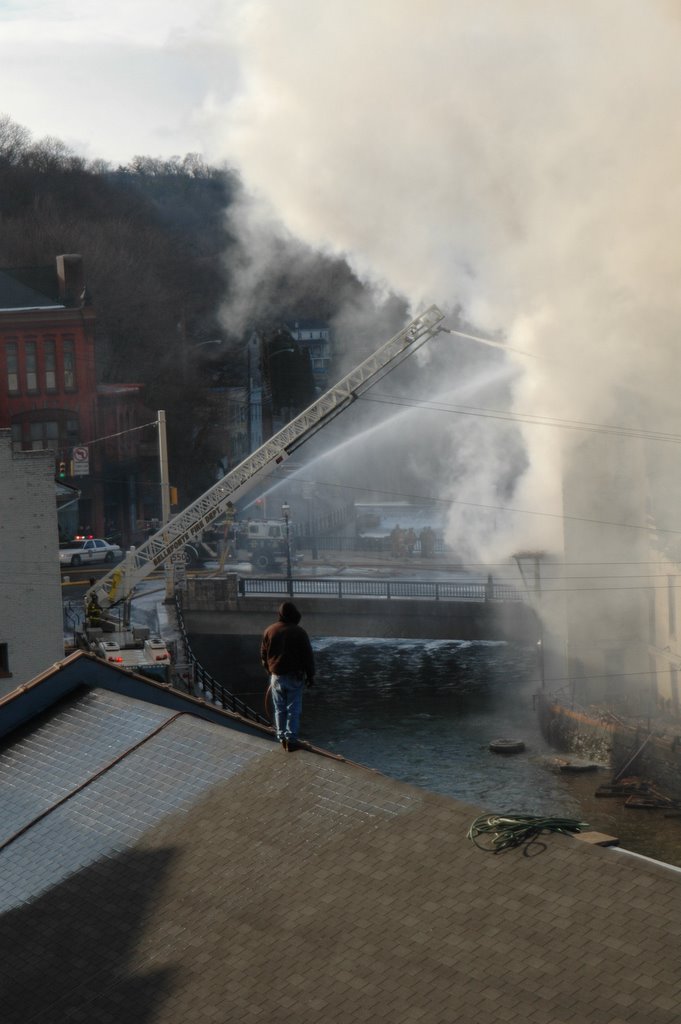
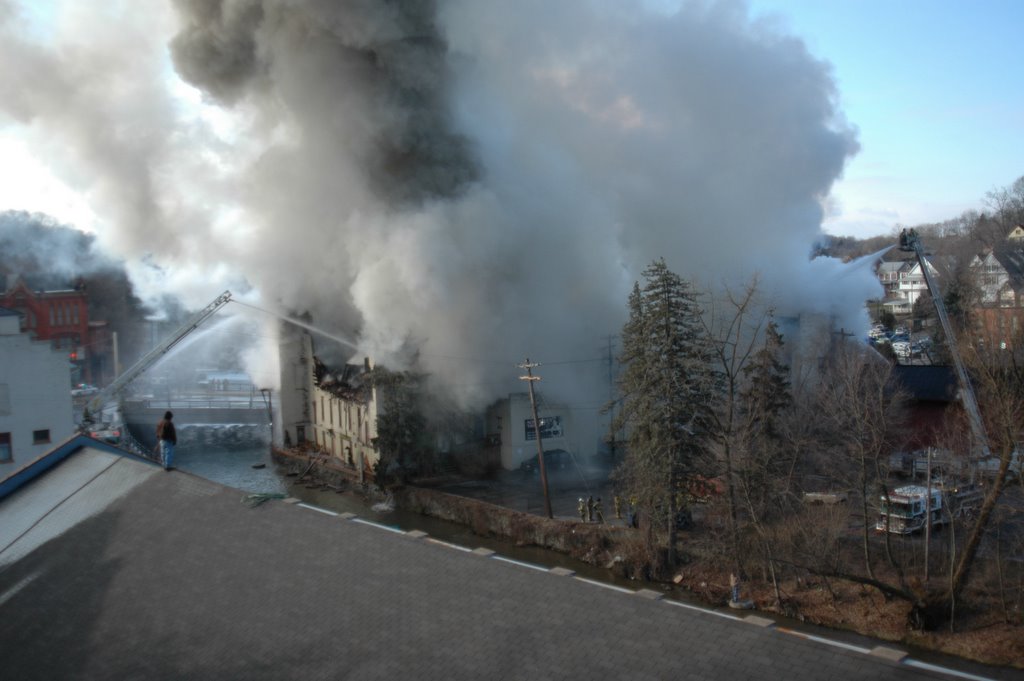
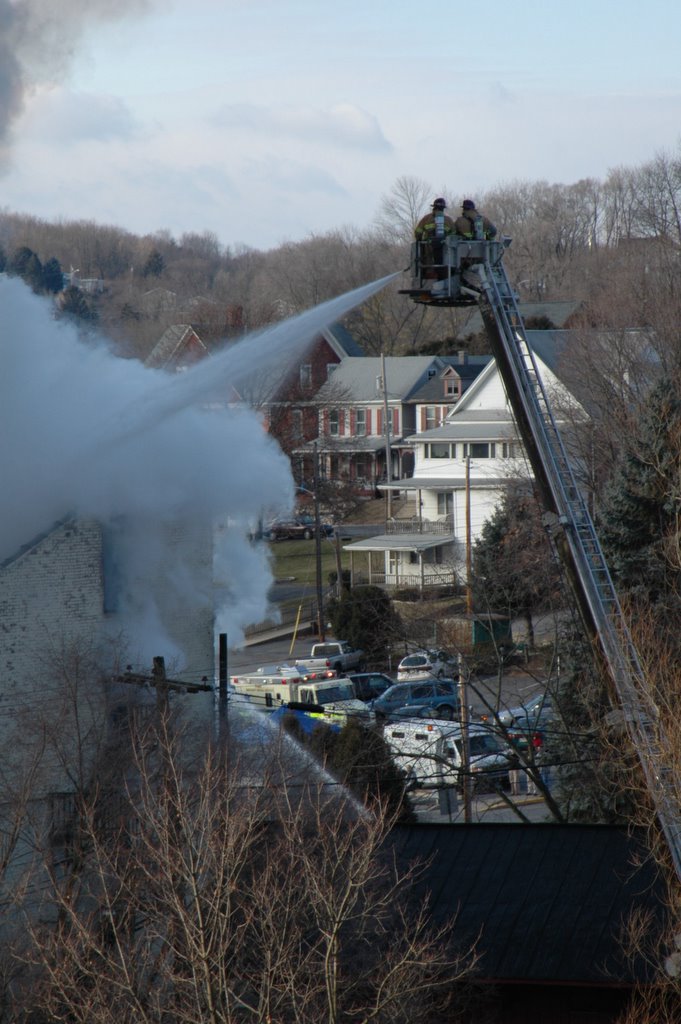
These are photos by Jason Gullickson of the Bush House fire. It's a total loss, from all accounts. This is the first time I've ever figured out the image-posting end of Blogger, so sorry if this is a little crude.
Update - the CDT has now gotten an article with photographs up.
Update - the CDT has now gotten an article with photographs up.




Hmm. The WTO has ruled that the European Union's anti-GMO policies are bullshit. While I agree that this is the case, and am happy to see those bio-luddites take one in the rhetorical chin, I'm not generally fond of the WTO and its international busy-bodyism. The only upside to this act of transnational interference is that it's in the service of giving a much-earned beating to a bunch of transnational busy-bodies who make a policy of such programs of interference.
Well, this will definitely test the hypothesis that central Pennsylvania has gotten past its historically well-earned reputation for racism as the Alabama portion of "Pittsburgh & Philadelphia & Alabama in between". Scranton dropped out of the Republican primary race, leaving just Swann & some nobody whose name I can't remember thirty seconds after having read it somewhere - Jim Panyard? Apparently the Steelers victory parade in downtown Pittsburgh was the last straw, and Scranton decided to pack it in.
Go, Swann.
Go, Swann.
I thought the change in smoke from yellow-brown to dark grey was a good sign, but Jay just came in from driving through town to work & said that the Bush House was gouting sparks & flame high enough to be seen from Rt. 550 on the other end of town. That's not good - my apartment is uphill & upwind from the fire. On the other side of a church and a funeral home, admittedly, so I don't think there's much of a chance, but you never do like to hear the words "sparks" and "upwind" associated with your domicile.
The Bush House on the corner of High and Water Streets in the heart of Bellefonte is on fire. Looks like one or more of the rooms of the hotel on the upper floors caught fire. There's a pretty impressive tail of smoke obscuring the water gap & most of the northeastern arm of the Bald Eagles from my office window. I freaked out when I first saw the fire-trucks, because Ben Hauger's apartment building is right across Water Street from the fire, but it didn't look like a flamer or sparker, so it probably won't jump buildings now that most of the fire companies in the county are on the scene or arriving.
Tuesday, February 07, 2006
This could be a significant problem for those of us who are prone towards walking along roads with their noses stuck in books. If the hybrid is actually that quiet at slow speeds - and I'm faintly suspicious of this story, given the lack of statistics or tangible studies quoted - then they could be quite dangerous to those of us who just don't pay attention to what we "see" while on foot. I don't quite see why they don't use electronic imitations of "road noise" to fake the aural footprint of a real car, but then, I've never really understood why cel phones don't do the same with the "yelling" problem caused by folks used to landline phones.
Via Micky Kaus.
Via Micky Kaus.
Monday, February 06, 2006
Small Pink Mouse solved the Den Beste mystery for me - he's blogless for the time being. I'll have to keep an eye on dotclue for updates.
I'm reading Paddy Griffith, and he says something interesting in the introduction to Battle Tactics of the Civil War, to the effect that Stephen Crane & others talking about the Civil War in the Victorian generation introduced new & modern ways of thinking about war. In effect, Griffith argues that the sense in which the American Civil War was a "modern war", not in the tactical or strategic sense (he calls Sherman "medieval", which I think is rather a mistake, in that Sherman's attitudes are more Thirty Years War than War of the Roses) or even technological sense - but rather in a narrational sense. Even the organizational techniques of mass conscription was an innovation of the 1790s.
Griffith says that the introduction of mass literacy & mass authorship & the modern postal & newspaper culture transformed the way that Napoleonic carnage was interpreted & felt by a newly egalitarian culture. The impersonality and the sense of futile butchery was not, in this view, a novelty to the American Civil War, but rather a novelty to society, which was directly encountering the horrors of Napoleonic war via the torrent of letters and newspaper accounts flooding home from each new abbatoir.
Griffith says that the introduction of mass literacy & mass authorship & the modern postal & newspaper culture transformed the way that Napoleonic carnage was interpreted & felt by a newly egalitarian culture. The impersonality and the sense of futile butchery was not, in this view, a novelty to the American Civil War, but rather a novelty to society, which was directly encountering the horrors of Napoleonic war via the torrent of letters and newspaper accounts flooding home from each new abbatoir.
Some years I seem to be more hostile to pop culture than others. Is it just me, or is the spectacle of Harrison Ford violating the corpse of Dr. Seuss for the NFL kind of... tacky? That, and the Franklin/Neville "Star-Spangled Banner" was just plain bad. Oh, and the Rolling Stones have been horrible self-parodies since at least the early Eighties, and probably before - I generally haven't paid that much attention. Can we get Sir Paul back?
Yay, Steelers.
Yay, Steelers.
Friday, February 03, 2006
New Energy Currents at Winds of Change. The article on towerless & high-altitude wind turbines is the most mind-melting item this time around. I just have this mental image of ten tons of windturbine coming unmoored & hurtling at terminal velocity from 15,000 feet into rush-hour traffic or something else more like a bad Michael Bay action scene than what I normally expect of reality.
Boy, was Tower of the Future a major disappointment. Saki Hiwatari's Please Save My Earth is a great, skiffy romp, a reincarnation soap-opera with a bunch of likeable and flawed characters. She has a reaccuring problem with talking-heads and the usual Japanese inclination towards woolly-headed, abstract idealism, but the manga works on a visceral and emotional level. PSME is one of my regular buys, and I haven't regretted a volume so far. I wish I could say the same about Hiwatari's Tower of the Future, which is some sort of minor-key later project of hers which CMX started publishing a few months back with almost zero fan-fare. Now that I've read the first two volumes, I can see why they weren't talking about it.
Basically, the story is about an only child named Takeru, who's supposed to be imaginative and a dreamer, and how his mother dies & he finds out that he has a bastard older sister. There's some sort of skiffy fringe about a little kid named Zen, but by the end of the second volume Hiwatari hasn't even come close to explaining what that's about except that Zen's trying to get the hero to hook up with the nominal heroine, who's barely been introduced as of that point.
Now, I say that Takeru is supposed to be imaginative, but his dreams are really tedious - the worst kind of RPG-style and-then-this-cool-thing-happens-for-this-airy-reason fantasy-plotting crap. He doesn't come across as particularly geekish, or charming, or even particularly gangly or awkward. He's just a dick. A passive-aggressive, selfish, unlikeable, undistinguished teenaged dickhead. He treats everyone around him like shit, and even his own motivations are poorly established & worse-expressed. Even when his victim-saint of an older sister shows up, the story doesn't really pick up, as she is, as I said, a walking stereotype of offended, vulnerable, abused virtue. And she's got a silly name - Hojyu? Honju? Something like that.
At any rate, I gave it two volumes, nothing happened, the page count was short, and I've got better things to do with my manga money. Dropped.
Basically, the story is about an only child named Takeru, who's supposed to be imaginative and a dreamer, and how his mother dies & he finds out that he has a bastard older sister. There's some sort of skiffy fringe about a little kid named Zen, but by the end of the second volume Hiwatari hasn't even come close to explaining what that's about except that Zen's trying to get the hero to hook up with the nominal heroine, who's barely been introduced as of that point.
Now, I say that Takeru is supposed to be imaginative, but his dreams are really tedious - the worst kind of RPG-style and-then-this-cool-thing-happens-for-this-airy-reason fantasy-plotting crap. He doesn't come across as particularly geekish, or charming, or even particularly gangly or awkward. He's just a dick. A passive-aggressive, selfish, unlikeable, undistinguished teenaged dickhead. He treats everyone around him like shit, and even his own motivations are poorly established & worse-expressed. Even when his victim-saint of an older sister shows up, the story doesn't really pick up, as she is, as I said, a walking stereotype of offended, vulnerable, abused virtue. And she's got a silly name - Hojyu? Honju? Something like that.
At any rate, I gave it two volumes, nothing happened, the page count was short, and I've got better things to do with my manga money. Dropped.
Thursday, February 02, 2006
I ran up against my physical limitations yesterday when I tried jogging for a bit instead of just walking. I could do the running without tiring, but I quickly hit the edge when I started breathing heavily. Or, at least, trying to breath heavily. There just isn't much depth to my wind anymore - I couldn't get that deep swing-intake of air necessary to keep going for more than three hundred yards or so.
I'm not coughing or anything, or wheezing, or suffering in the usual asthmatic ways, but there's just no lung capacity to spare for anything more than a short sprint.
Damnit.
I'm not coughing or anything, or wheezing, or suffering in the usual asthmatic ways, but there's just no lung capacity to spare for anything more than a short sprint.
Damnit.
Finally saw Casablanca last night. As someone once said after reading Hamlet late in life, "why, it's nothing but a series of quotes strung together!"
Oh, and objectively? Bogart is a damned strange looking leading man. And I don't see the point of Ingrid Bergman. I was put off by her character asking about the "boy playing the piano", Dooley Wilson, who was twenty-one years older than Bergman, and in his late thirties at the time of filming. Talk about the attitudes of an age dating its cultural products...
Oh, and objectively? Bogart is a damned strange looking leading man. And I don't see the point of Ingrid Bergman. I was put off by her character asking about the "boy playing the piano", Dooley Wilson, who was twenty-one years older than Bergman, and in his late thirties at the time of filming. Talk about the attitudes of an age dating its cultural products...
Wednesday, February 01, 2006
Watched the state of the union speech, and accidentally missed the Shield. Wow, Hillary Clinton is kind of scary these days, isn't she? There was this horrible, glowering rictus on her face every time the cameras cut to her for a reaction shot. She makes Nixon in his prime seem like a paragon of hail-fellow-well-met bonhomie.
If the more optimistic and sunnier-dispositioned candidate almost always wins the presidency, then the Republicans would have to nominate the reptilian Gary Bauer in order for Sen. Clinton to charm her way back into the Oval Office. Or maybe not - Nixon managed to win against the Happy Warrior, didn't he?
If the more optimistic and sunnier-dispositioned candidate almost always wins the presidency, then the Republicans would have to nominate the reptilian Gary Bauer in order for Sen. Clinton to charm her way back into the Oval Office. Or maybe not - Nixon managed to win against the Happy Warrior, didn't he?
My new landlord does not, like the last one, have a convenient downtown office with a convenient mail-slot in the door for off-hours deposit of the rent-cheque. I'm a cheap bastard, and getting cheaper, so the prospect of wasting a stamp on the monthly rent fills my newly-saved soul with the fear of financial fire & brimstone. The secretary of the old landlord is cousins of some sort with the new landlord, and has indicated that she'll collect cheques if I insist, but this is kind of a slap-dash way of doing things, don't you think?
Wonder if I can talk the new landlord into doing Paypal? Eh, I guess not. Not unless I want to pay the transaction cost - steeper than I thought, really. 2.9%? What could keep a businesswoman from just sticking with personal accounts, which seem to be free?
Wonder if I can talk the new landlord into doing Paypal? Eh, I guess not. Not unless I want to pay the transaction cost - steeper than I thought, really. 2.9%? What could keep a businesswoman from just sticking with personal accounts, which seem to be free?
I got a circular this morning from a friend requesting I sign this petition to the Centre County Board of Commissioners against the introduction of no-paper voting machines, and requesting a transition to an optiscan system. While I have no real brief against electronic voting per se, I'm willing to see ground given on the subject in the interest of raising the general level of public trust in the voting system. If you live in the county, please consider signing the petition, not because the "Republicans[Democrats/Naderites/Bolivian Revolutionaries] are going to steal our votes!", but because you'd prefer a calmer political climate, with fewer unnecessary sources of irritation & distrust. Thank you.
Tuesday, January 31, 2006
Huh. Histories of the Rotary conventions. Looks like the Con has been as big as an average Rotary's for the last four years or so.
Via one of James Lileks' American Motel pages, which are intermittently very funny, when they're not pegging the nostalgia meter up into the mid-eights.
Via one of James Lileks' American Motel pages, which are intermittently very funny, when they're not pegging the nostalgia meter up into the mid-eights.
That new set of apartment buildings going up in downtown State College on the old Ambassador Building lot across from the Lutheran church is looking more and more elaborate as they get past concrete-blocks-and-girders to fiddling around with facades and such. When it's done, Beaver Canyon is going to be steeper and more oppressively city-like than ever. The only gap left will be that preposterous ground-level for-pay parking lot in front of the Cinema 5, stuck right in the middle of downtown like a rotted-out socket in the middle of a bright white smile. Multi-story parking deck construction in five, four, three, two...
But seriously, the construction boom in the county has been pretty impressive. I'm kind of surprised that traffic hasn't been worse than it has been. If the owners of the Academy lot & their peers have their way, once the construction companies wrap up their projects in State College, there's still a good chunk of work in the outer county to absorb the surplus labor & workforce. Unless, that is, some sort of credit crunch brings everything to a screeching illiquid halt. We'll see. Given the number of properties for sale around Bellefonte, I'm still wondering who or what the developers expect to fill that new semi-high-rise *with*.
But seriously, the construction boom in the county has been pretty impressive. I'm kind of surprised that traffic hasn't been worse than it has been. If the owners of the Academy lot & their peers have their way, once the construction companies wrap up their projects in State College, there's still a good chunk of work in the outer county to absorb the surplus labor & workforce. Unless, that is, some sort of credit crunch brings everything to a screeching illiquid halt. We'll see. Given the number of properties for sale around Bellefonte, I'm still wondering who or what the developers expect to fill that new semi-high-rise *with*.
Monday, January 30, 2006
Yesterday was rainy and miserable for most of the day, with a single one-and-a-half-to-two-hour break in the weather, as a trough between fronts ripped the clouds asunder & left Bellefonte basking under an unexpectedly warm winter sun and a clear blue sky. I, like half the town, took advantage of this break in the weather by getting out & walking all over town, prior to stomping out to the strip-mall on Bishop Street to pick up some dinner. I mis-gaged the timing a bit, and got caught in the next front for about a half-mile of wet misery, but was able to scurry back to the apartment in another, brief lull around sun-set.
Strange weather for January. Winter decided to hang out with its Polish cousins on the Ukrainian border this year, I suppose.
Strange weather for January. Winter decided to hang out with its Polish cousins on the Ukrainian border this year, I suppose.
Hmmm. The owners of the old Academy property that burned down last year are looking to rebuild. There's a sign out on Spring Street with a picture of a five-story apartment building & promising "high-end condominiums". This is not a tony neighborhood, mind you - the Academy was full of low-income housing rentals, and the rest of the neighborhood isn't in much better shape. In fact, you can find at least two partial ruins within a block of the Academy, partial ruins which look fully occupied. There's been some renovation going on up the hill on Allegheny Street, but it's still about as cracker as you can get on this side of Bald Eagle Mountain. Looks like Lifegate Baptist moved into that stone one-story across the road from the Academy's old driveway. I'm not sure you *can* gentrify that sort of neighborhood, but I suppose it's possible they're trying.
Friday, January 27, 2006
Hrm. Just as I started seriously cutting back on my personal spending with an eye towards a radical savings plan last fall, the economy went into the tank in a big way. Er... oops?
h/t Jonah Goldberg @ the Corner.
Update: or... not so much. I'm confused. A drop in governmental military spending is responsible? How mind-warping.
h/t Jonah Goldberg @ the Corner.
Update: or... not so much. I'm confused. A drop in governmental military spending is responsible? How mind-warping.
Thursday, January 26, 2006
Wednesday, January 25, 2006
OK, I guess I do have something to relate. While I was stomping and sliding around campus Monday night, I marveled at how things change when you're not paying attention. That construction out on the old Lot 80 is wrapping up, and there's much less in the way of parking deck than I really expected. All the big, open spaces of the campus of my memory have been filled in with vaguely modern brick buildings of mysterious purpose and dubious provenance. There's another building where the old parking lot for North Commons used to be. What do students do for parking on campus any more? There aren't nearly enough parking decks to make up for the lost spots, if I'm calculating properly.
Well, I take that bit about all the big open spaces being gone. The big, empty, le Corbusier-ish lot around the bunker-esque Smeal College of Business building is still empty, except for a few straggly little trees which look like they were planted Oct. 2004 at the latest. Is this an expression of the power and influence of the Smeal College of Business, that it can defend its space against the encroachments of endowment-driven hyperconstruction, or a reflection of the disinterest of the said endowing alumni in putting their names on new buildings for the colorless Smeal College of Business?
They haven't started building anything on Old Main's lawn, have they?
Well, I take that bit about all the big open spaces being gone. The big, empty, le Corbusier-ish lot around the bunker-esque Smeal College of Business building is still empty, except for a few straggly little trees which look like they were planted Oct. 2004 at the latest. Is this an expression of the power and influence of the Smeal College of Business, that it can defend its space against the encroachments of endowment-driven hyperconstruction, or a reflection of the disinterest of the said endowing alumni in putting their names on new buildings for the colorless Smeal College of Business?
They haven't started building anything on Old Main's lawn, have they?
Some days you don't have much to say. Except that it's a strange but amusing world.
ht Doktor Frank, INDCJournal.
ht Doktor Frank, INDCJournal.
Tuesday, January 24, 2006
Holy shit! A blog commenter and an alert librarian uncovered a hobbyist jihadi planning on branching into actual terrorism in Dayton. The librarian reported the jihadi's browsing patterns, and the commenter was recruited via fora messages & email by the jihadi, who thought he was a fellow would-be maniac. Just some random cashier in a podunk town in the Western Reserve.
Went out again before color-up at Bar Bleu - Monday nights just aren't clicking for me, looks like. Oh, well, at least it isn't a cash game. I went walking on campus afterwards to kill time, and found ten guys playing a half-dollar ante game up in Findlay Commons in East Halls - fifty dollar minimum buy-in. I don't suck, but that's about five times over my current comfort-level, and I definitely don't have the confidence to blow fifty or sixty bucks on a single sitting. While I was on campus - I had promised to pick someone up off the last flight into University Park, and had hours to kill - I took the opportunity to get a new "Resident PA" library card at Pattee. The circulation desk ladies boggled at my 1990 student ID, then quickly ran through the process of cutting a new card. I guess they've given up on photo IDs. Had time to run back into the stacks and borrow a bunch of books which I'd been looking for in the county library system & not finding - Griffith's Battle Tactics of the Civil War, McWhiney's Attack and Die, Hennessey's Return to Bull Run, and Cozzens' book on Iuka & Corinth while I was at it. The late fees have gotten truly fearsome - $3.00 a day after the due-date or recall-date.
I had taken a pile of books I've never finished reading & manga I had gone sour on down to Webster's to see if I could get the piles out of my increasingly cramped apartment, & maybe get some extra money. Mostly paperback novels, crap trade paperback histories, and old manga like flipped Peach Girl, Battle Royale, Eden, Here is Greenwood, and random detrius like a Grisham novel or two or an extra volume of Parasyte that I accidentally double-ordered. I would have been happy with $100, cash, & wouldn't have bothered taking back anything at $50. They gave me a cheque for $250. No wonder used books are so pricey these days. It's all going towards buying inventory!
I had taken a pile of books I've never finished reading & manga I had gone sour on down to Webster's to see if I could get the piles out of my increasingly cramped apartment, & maybe get some extra money. Mostly paperback novels, crap trade paperback histories, and old manga like flipped Peach Girl, Battle Royale, Eden, Here is Greenwood, and random detrius like a Grisham novel or two or an extra volume of Parasyte that I accidentally double-ordered. I would have been happy with $100, cash, & wouldn't have bothered taking back anything at $50. They gave me a cheque for $250. No wonder used books are so pricey these days. It's all going towards buying inventory!
Saturday, January 21, 2006
I'm here at the Con's yearly January committee-conference, aka "ComCon". It's a great SMOFfy retreat-type kind of event, and I'm enjoying myself immensely this year. The game show folks get in some practice Friday night by running a version of the game show they put on for last summer's convention proper, and I ended up being one of the participants. I don't know if the questions have gotten easier recently, or if I'm more alert these days, but I got a lot of mockery from the crowd for claiming at first that I wasn't good at trivia, and then winning by a good margin. The questions are (mostly) multiple-choice, and I've always tested well on multiple choice.
Managed to scrape together a pretty good fifty-cent cash game in one of the free suites, ran until 3:30 AM. I guess the exercise-and-diet regimen is working, because I had tons of energy & could have gone until six. I did pretty well, too - I may not be a good poker player yet, but I'm approaching fair-to-middling, which is good enough for the level I'm playing at, I think.
Oh, the work? My department is running on rails these days; I just have to talk to the comptroller about supply orders, and maybe check in on the membership cap discussion, and maybe talk to the chief of staff about replacement staff for the folks who inevitably get bored with the work. Lots of turnover in Registration.
Managed to scrape together a pretty good fifty-cent cash game in one of the free suites, ran until 3:30 AM. I guess the exercise-and-diet regimen is working, because I had tons of energy & could have gone until six. I did pretty well, too - I may not be a good poker player yet, but I'm approaching fair-to-middling, which is good enough for the level I'm playing at, I think.
Oh, the work? My department is running on rails these days; I just have to talk to the comptroller about supply orders, and maybe check in on the membership cap discussion, and maybe talk to the chief of staff about replacement staff for the folks who inevitably get bored with the work. Lots of turnover in Registration.
Thursday, January 19, 2006
Wednesday, January 18, 2006
Dude! Cool article about a pristine meteor crater site, known as "Wabar", deep in the Empty Quarter of Saudi Arabia, which Beduin lore holds (falsely!) to be the divinely-destroyed city of Ubar. Why falsely? Apparently because the site post-dates the Koranic story of Ubar by at least nine hundred years, and it might be less than two hundred years old. That, and they've found the actual site of Ubar hundreds of miles away. But the crater site itself is apparently a deeply cool place in and of itself, regardless of the lore. The details of just how inhospitable the location is - "On our weeklong third expedition, furious sandstorms destroyed our camp twice, and the temperature never dropped below 40 degrees C, even at night" - sound almost like tall tales.
Link via Rantburg.
Link via Rantburg.
Damnit, where has Chizumatic disappeared to, now? He said something about moving servers, but I thought there'd be a pointer to the new address for at least a few days in between, so's I could transfer my blogroll link over at my leisure. " Where have you gone, Steven Den Beste? Our nation turns its lonely eyes to you."
The list of classic science fiction which I've never read is about as long as your arm. Among those lacunae is the original War of the Worlds, although I seem to have some childhood memory of reading a kidification of it once, or possibly just fragments which I was too young to really retain at the time, like those copies of Gulliver's Travels and the Travels of Marco Polo which I stumbled through uncomprehending at too young an age while staying at my grandparents' farmhouse for the Christmas season.
Anyways, a friend surprised me with the gift of a collection of H.G. Wells stories "as originally published", so I cracked it open & read the War of the Worlds in between doing my mid-week laundry. It's much better-written than I really expected of H.G. Wells, whom I mostly knew from his technocratic enthusiasms, weak-minded secular socialism, and credulous fellow-traveling endorsement of the Bolsheviks. The story is full of atmospheric detail, never treats the human interest as wall-paper or a distraction, and is strikingly well-paced and active for what, in my ignorance, I had thought of as a "literary" book. The ending was surprisingly affecting, and aside from some rhetorical and structural details which betray the book's pre-modernist origins, it holds up remarkably well for a book which is well into its second century. It's by far a better story than any of the cinematic or radio adaptations made of it over the years. Although the latest Spielberg version was as close an adaptation as I had been told it had been, the original novel was still much better-paced, less sentimental, and more honest in its plotting and action.
The one glaring fault of the book is something that I suspect gets regularly purged from more modern versions of the novel, part of that whole "as originally published" deal, I suppose. There's a nasty and harsh episode of anti-Semitism square in the middle of the book, as we join a small group of refugees attempting to cross the North Road in full London-evacuation-panic, and the protagonist's brother attempts to save a "Jew" from being crushed under the wheels of what seems like a half-dozen carts across the course of three pages. The "wretch" in question is depicted as a wild animal, crazed and grasping after his gold even after his back is broken & he lies dying in the panicked highway, and bites the hand of his would-be saviour. I mean, this is some of the rawest prejudicial bigotry you can get without descending into actual hate. The book was published at the height of the Dreyfus Affair, and I can't help but wonder what the politics are of such a leftist as Wells indulging in this sort of rank Jew-baiting at the very moment when Western political anti-Semitism was at its peak on the Right.
Pretty good essay on the book here, btw. Says a lot about Wells' use of geography and rhetoric to slowly build an effect which multiplies the impact of the action of the story, better than I could explain it, I think.
Anyways, a friend surprised me with the gift of a collection of H.G. Wells stories "as originally published", so I cracked it open & read the War of the Worlds in between doing my mid-week laundry. It's much better-written than I really expected of H.G. Wells, whom I mostly knew from his technocratic enthusiasms, weak-minded secular socialism, and credulous fellow-traveling endorsement of the Bolsheviks. The story is full of atmospheric detail, never treats the human interest as wall-paper or a distraction, and is strikingly well-paced and active for what, in my ignorance, I had thought of as a "literary" book. The ending was surprisingly affecting, and aside from some rhetorical and structural details which betray the book's pre-modernist origins, it holds up remarkably well for a book which is well into its second century. It's by far a better story than any of the cinematic or radio adaptations made of it over the years. Although the latest Spielberg version was as close an adaptation as I had been told it had been, the original novel was still much better-paced, less sentimental, and more honest in its plotting and action.
The one glaring fault of the book is something that I suspect gets regularly purged from more modern versions of the novel, part of that whole "as originally published" deal, I suppose. There's a nasty and harsh episode of anti-Semitism square in the middle of the book, as we join a small group of refugees attempting to cross the North Road in full London-evacuation-panic, and the protagonist's brother attempts to save a "Jew" from being crushed under the wheels of what seems like a half-dozen carts across the course of three pages. The "wretch" in question is depicted as a wild animal, crazed and grasping after his gold even after his back is broken & he lies dying in the panicked highway, and bites the hand of his would-be saviour. I mean, this is some of the rawest prejudicial bigotry you can get without descending into actual hate. The book was published at the height of the Dreyfus Affair, and I can't help but wonder what the politics are of such a leftist as Wells indulging in this sort of rank Jew-baiting at the very moment when Western political anti-Semitism was at its peak on the Right.
Pretty good essay on the book here, btw. Says a lot about Wells' use of geography and rhetoric to slowly build an effect which multiplies the impact of the action of the story, better than I could explain it, I think.
Monday, January 16, 2006
Nothing quite like walking into a restaurant and getting stared at by the entire wait staff in a row, like you're some kind of freakjob for wanting to *eat* on a Sunday. When asked what was going on, one of them, with a "duh!" expression, said "why aren't you watching the game?" Turned around, and the TV by the entrance was playing the Pittsburgh-Indianapolis game. Whoops, forgot it was on.
Oh, BTW? Don't order a burger at Outback assuming that it'll be lighter than the other monster meals. It isn't; in fact, it might be a heavier meal than the twice-as-expensive steaks or pasta meals. Enormous burger, and way, way too many fries. Pretty good, though. Dave yelled at me to stop closing my eyes while eating, and I told him I was just enjoying the calories.
Oh, BTW? Don't order a burger at Outback assuming that it'll be lighter than the other monster meals. It isn't; in fact, it might be a heavier meal than the twice-as-expensive steaks or pasta meals. Enormous burger, and way, way too many fries. Pretty good, though. Dave yelled at me to stop closing my eyes while eating, and I told him I was just enjoying the calories.
Thursday, January 12, 2006
I just spent a few minutes checking out tax filing status on gambling winnings. Why? Because I had a better night than usual at HiWay Pizza, and it was the championship night for the series. Apparently they weren't kidding about a serious prize for the final winner. Having read over the W-2G instructions, it looks like my winnings are not *quite* serious enough to qualify for filing. Please correct me if I'm mis-reading that webpage, but it *looks* like the minimum reporting amount is $600 per wager. Now, this is an insanely high minimum reporting requirement, and it totally excludes the professional poker players who make their living at the $10-$25 tables in the real casinos, but if it means that I don't have to do the paperwork on my (by IRS standards, modest) one-time free-tournament windfall, I'm all for it. Meanwhile, this sucker is going straight into savings, you betcha.
Oh, yes: WAAHOO! What a night to catch fire!
Oh, yes: WAAHOO! What a night to catch fire!
Wednesday, January 11, 2006
Huh. There's noise to the effect that Suncoast Video is deep-sixing its manga section, due partly to the termination of their relationship with book distributor Ingram, and partly to a serious downsizing of Suncoast/Mediaplay itself. I guess it was fortuitous that I chose this month to shift heavily to pre-ordering through my local comics shop, wasn't it?
Monday, January 09, 2006
Nooo! Damn you, reviewer-pirated spoiler-mines! Every year, one of the shows I follow gets the first four episodes of the season shipped out to the critics, and every year, some nameless toad passes his or her set to the peer-to-peer types, and suddenly the intarweb is alight with universally-known spoilers three episodes ahead of what I've seen. This time, it's Battlestar Galactica. I didn't need to know that I will not spoil anyone else, go elsewhere for your fix!
Oh, man, it's beautiful outside today. That mass of warm air over north Texas I was just looking at on the Jan. 7 QC charts is blowing overhead right now, with sunlight, warm temperatures, and seriously blustery winds. I nearly got blown over while walking around the lower industrial park a few minutes ago. It's more like late March than mid-January out there.
I fear that I'll be even more gnomic and inaccessible in the next year, as I pare back my presence in the world with an eye towards Scroogedom. I spent the weekend watching old anime & reading a book which the rest of the blogsphere was talking about four years ago - Koba the Dread: Laughter and the Twenty Million.
Koba the Dread is more valuable as a literary tract than true history - it's not really scholarly in the accepted sense. But Amis, as a novelist of stature and talent, knows how to turn a phrase, and does a rapping good job at manipulating & magnifying the metaphors & similes of the various scholars which he summarizes - Conquest, Tucker, Solzhenitsyn, Shalamov, etc. I have to admit that I've never read the Gulag Archipelago, or any of the other primary or secondary works on the Russian catastrophe, so I'm not exactly the best of audiences for this sort of thing.
But I teared up at the end, when Amis discusses how his infant daughter, in a fit of terrifying tears, was nick-named by his household after a Russian prison, and that nickname stuck throughout her childhood: Clio, named after the muse of history, became Butryka, the least of the Soviet hells. Ahh, I'd have to quote a dozen paragraphs to reproduce the effect. I've seen Amis quoted enough as it is. If you're curious, read the book.
Koba the Dread is more valuable as a literary tract than true history - it's not really scholarly in the accepted sense. But Amis, as a novelist of stature and talent, knows how to turn a phrase, and does a rapping good job at manipulating & magnifying the metaphors & similes of the various scholars which he summarizes - Conquest, Tucker, Solzhenitsyn, Shalamov, etc. I have to admit that I've never read the Gulag Archipelago, or any of the other primary or secondary works on the Russian catastrophe, so I'm not exactly the best of audiences for this sort of thing.
But I teared up at the end, when Amis discusses how his infant daughter, in a fit of terrifying tears, was nick-named by his household after a Russian prison, and that nickname stuck throughout her childhood: Clio, named after the muse of history, became Butryka, the least of the Soviet hells. Ahh, I'd have to quote a dozen paragraphs to reproduce the effect. I've seen Amis quoted enough as it is. If you're curious, read the book.
Friday, January 06, 2006
I put in a three-month order for over two dozen manga volumes at the 'Swap last night. This is something in the way of a test of their discounting and ordering service. What I'm hoping for is that this will result in fewer fruitless drives around the county looking for manga, and a slightly cheaper per-volume cost. What I'm fearing is an increase in delays and general irritation. What really sticks with me, once I listed off everything I was planning on getting for a three-month period, and laid it all down next to each other on a sheet of paper, is how large of a fraction of my income goes to this sort of thing. It's essentially eaten up the overwhelming majority of my entertainment budget.
Thursday, January 05, 2006
While ambling through the SuperWalMart on North Atherton yesterday evening (having waxed greatly wroth upon finding that the Comic Swap had closed early on their alleged new-comics-day for the third week in two months - #$%!, and thus possessed of a sudden and unwelcome surfeit of free time prior to the night's poker session), I came upon this. How mind-warping!
Wednesday, January 04, 2006
Witold Rybczynski's taste in McMansions is not quite perfectly wrongheaded. The seventh slide in his presentation, of a pseudo-Queen Anne house from Pacific Heights, CA, shows a house which is not totally repulsive, and he's got it properly included in his set of four "good McMansions". But of the other three, and the four McMansions he cites as offensive to the eye - my god, what have they been putting in his pinot noir?
The fifth slide, the first of the "good McMansions", shows a sprawling, psychotic white mess of a house, with an overbearing centre-line and a frightening overbite, as if the facade was shifting forward in preparation of an impending collapse, or as if a recent earthquake had pancaked a missing second floor in between the oversize gables and the compressed, hunched first floor. The sixth slide is of a melange that rather looks like an A-frame molesting a mock-Tudor. The eighth slide, of a pseudo-Georgian misfire with a disturbing roofline which looks as if someone had hacked holes in roof on either side of the central building, is not quite as horrifying as the other two, but still! Yet, in each case, his commentary is laudatory and admiring. Incomprehensible.
Now, I'm not saying that his four "bad McMansion" examples are much of anything one way or the other, but in comparison with his favorites, they're models of balance, proportion and calm. The fourth slide, with the house with a brick facade and a vinyl side, is a bit of an aesthetic bodge, yes, but in comparison with House Overbite? I think not!
The whole line of argument - that the oversized houseness of the McMansion is inherently bad in aesthetic terms - is, I think, a particularly foul case of class snobbery hiding within the cloak of "good taste". Rybczynski complains quite a lot about the lack of coherent "style" in his "bad McMansions", but why should new buildings be perfect photocopies of decades-old or centuries-old housing styles? The houses he savages are well-proportioned and to scale. The houses he prefers are monstrous and alienating. I rather suspect that Rybczynski prefers that the inhabitants of designed buildings be alienated from their domiciles. Well, nuts to that!
The fifth slide, the first of the "good McMansions", shows a sprawling, psychotic white mess of a house, with an overbearing centre-line and a frightening overbite, as if the facade was shifting forward in preparation of an impending collapse, or as if a recent earthquake had pancaked a missing second floor in between the oversize gables and the compressed, hunched first floor. The sixth slide is of a melange that rather looks like an A-frame molesting a mock-Tudor. The eighth slide, of a pseudo-Georgian misfire with a disturbing roofline which looks as if someone had hacked holes in roof on either side of the central building, is not quite as horrifying as the other two, but still! Yet, in each case, his commentary is laudatory and admiring. Incomprehensible.
Now, I'm not saying that his four "bad McMansion" examples are much of anything one way or the other, but in comparison with his favorites, they're models of balance, proportion and calm. The fourth slide, with the house with a brick facade and a vinyl side, is a bit of an aesthetic bodge, yes, but in comparison with House Overbite? I think not!
The whole line of argument - that the oversized houseness of the McMansion is inherently bad in aesthetic terms - is, I think, a particularly foul case of class snobbery hiding within the cloak of "good taste". Rybczynski complains quite a lot about the lack of coherent "style" in his "bad McMansions", but why should new buildings be perfect photocopies of decades-old or centuries-old housing styles? The houses he savages are well-proportioned and to scale. The houses he prefers are monstrous and alienating. I rather suspect that Rybczynski prefers that the inhabitants of designed buildings be alienated from their domiciles. Well, nuts to that!
I bought Lincoln's Wrath on a whim on the way down to Florida last month. I'm kind of regretting that impulse buy, and not only because I paid retail for something Amazon's selling at over a 30% discount. It looked interesting because I've not read as much about Civil War civilian politics as I would like, and the book's emphasis on the interaction of newspapers and politics in the Civil War and the antebellum really grabbed my attention, despite the rabble-rousing histrionics of its subtitle, "Fierce Mobs, Brilliant Scoundrels, and a President's Mission to Destroy the Press".
It's been a tough slog. I've started the book twice so far. The book covers a lot of angles which are novel to me - the exact nature of the publishing contracts which represented the financial connection between the era's publishers and their client-politicians, the economics of the printing trade, some of the alliances between politicians and publishers other than Seward and Weed - and that's all fine and great, and highly welcome. What's not so welcome is the quality of the prose, or rather, the appalling lack thereof.
I'm not sure whether years of exposure to the rather minimal writing abilities of the small-town editors and publishers who produced their research material have stunted the authors' sensibilities, or whether the authors' inherent indifference to the rhetorical proprieties rendered them more likely to survive a long term of exposure to the subject matter and emerge on the other side of the ordeal with the raw material for a book-length treatment. One rather fancifully imagines the project beginning with one writer, driven mad and incoherent by his extended exposure to the non-Websterian horrors of small-town Democratic partisan prose, and a much-put-upon publisher attempting to salvage the project by inserting a (presumably) sane collaborator to shape the mess into a publishable manuscript, only to have that academic ringer driven mad in turn by his secondary exposure to the figurative necronomicon of the commonwealth's own mad Arab Abdul Alhazred, John Hodgson and his Jeffersonian.
I guess I'll keep cracking away at it, but this is history in a rawer form than I'm really comfortable with.
It's been a tough slog. I've started the book twice so far. The book covers a lot of angles which are novel to me - the exact nature of the publishing contracts which represented the financial connection between the era's publishers and their client-politicians, the economics of the printing trade, some of the alliances between politicians and publishers other than Seward and Weed - and that's all fine and great, and highly welcome. What's not so welcome is the quality of the prose, or rather, the appalling lack thereof.
I'm not sure whether years of exposure to the rather minimal writing abilities of the small-town editors and publishers who produced their research material have stunted the authors' sensibilities, or whether the authors' inherent indifference to the rhetorical proprieties rendered them more likely to survive a long term of exposure to the subject matter and emerge on the other side of the ordeal with the raw material for a book-length treatment. One rather fancifully imagines the project beginning with one writer, driven mad and incoherent by his extended exposure to the non-Websterian horrors of small-town Democratic partisan prose, and a much-put-upon publisher attempting to salvage the project by inserting a (presumably) sane collaborator to shape the mess into a publishable manuscript, only to have that academic ringer driven mad in turn by his secondary exposure to the figurative necronomicon of the commonwealth's own mad Arab Abdul Alhazred, John Hodgson and his Jeffersonian.
I guess I'll keep cracking away at it, but this is history in a rawer form than I'm really comfortable with.
Budgeting for the next few months of manga purchases, taking into account the new manga club promotion of the Comic Swap of State College... boy, do I spend a hell of a lot on comics. Enough so that if I want to keep to an overall budget, I'm going to have to essentially cut out my DVD and book purchases, or at least cut them to a bare minimum.
BTW - the deal from the 'Swap is a straight one-free-for-ten-purchased stamp-card offer. Apparently they're leery of another storefront-and-a-Diamond-wholesale-discount competitor springing up in the county. It's enough of a benefit that I'm planning to shift the vast majority of my purchases to them for three months & seeing how it works out.
BTW - the deal from the 'Swap is a straight one-free-for-ten-purchased stamp-card offer. Apparently they're leery of another storefront-and-a-Diamond-wholesale-discount competitor springing up in the county. It's enough of a benefit that I'm planning to shift the vast majority of my purchases to them for three months & seeing how it works out.
Tuesday, January 03, 2006
If I understand the substance of this argument, then they're saying that because advertisers chase page real estate instead of advertising transactions, that online advertising will capture at best half the business which once went to the periodical market. It sounds like they're confusing method with goal, but what do I know? I would just assume that in a scarce market, more dollars thrown at less real-estate would result in more expensive real estate. I suppose it's possible that advertising isn't subject to the laws of supply and demand, but really, I'm stupid enough that I'd naturally assume that the object of supply scarcity in this equation would be attention, not the ads themselves.
Monday, January 02, 2006
Thursday, December 29, 2005
Boy, I love to fly. It's like a geography-themed rollercoaster. Shame it costs so much...
I picked up some manga I hadn't exactly been eager to read, due to this and that and the other thing. Surprisingly, none of the volumes in question were disappointing; some were actually quite promising. I suppose that's the value of low expectations.
Her Majesty's Dog's biggest problem is that the publisher, Go!Comi, has foolishly insisted on selling copies exclusively through the Waldenbooks/Borders book chain. The closest stores I've been able to find in this chain are in Allegheny County, although both my sister and the clerk in the Robinson Town Centre Borders Express both insist that there's a Borders Express somewhere within the city limits of Altoona. I suppose I'm going to have to go find it in February, because that's when the second volume of Her Majesty's Dog is due, and I don't want to have to trek out to Northway Mall on such a flimsy premise.
HMD is a pretty good book - the protagonist is a magician who derives her power from the knowledge of the true names of things, people, and identities. The dog of the title is her inugami, or dog-spirit - essentially a familiar or pet demon in the alternating forms of a lion-huge demon-dog and a teenaged bishounen. There's a lot of racy humor at the expense of the heroine, who has the blase, peculiarly innocent jadedness of the Japanese rustic. (There must be some essays out there on the distinctly Japanese inversion of the usual Western innocent country/depraved city sexual duality, but my aversion to pomo is cognitively blocking my google fu, sorry.) It was apparently written as a "horror" title, but the writer admits that she's not much for serious horror, and it plays more as slightly fantastic high-school comedy. The first chapter or so is a bit bare-boned and schematic, but the writing settles down quickly enough, and by the end I was looking forward to more.
Crossroad another shoujo from Go!Comi was less promising. Shojo Beat and various relevant websites have been full of obnoxious, dopy ads for the comic which made it sound like the most bare-boned of harem-grade "visual novel" tedium. I was pleasantly surprised to find that it wasn't nearly as precious or simple-minded as the advertising threatened. The protagonist is the daughter of a fairly worthless, aging tart who keeps accumulating children from even more worthless beaus, and generally dumping them on the doorstep of her much-put-upon mother, while "Rumiko-mama" goes charging off in search of another meal-ticket. While the protagonist is the actual body-child of the soon-absent mother, two additional step-brothers seem to have just been dumped on the family, and who knows where the second girl came from? The woman who actually kept some semblance of a family together over the years dies as the book opens, leaving the kids effectively abandoned and semi-doomed.
The heroine of Crossroad surprisingly *doesn't* rise immediately to the occasion, mostly because a lifetime of abandonment and broken promises has left her suspicious and nearly pathologically antisocial. Even better, she's not always right, or even particularly sympathetic. There's plenty of room for a lot of character arc in this one. The one big problem with the manga is that the author has a bit of a tendency to let off liberal-concerned-social-conscience steam in the form of inappropriate, doofy sermons from the heroine, and that sort of thing isn't made any more palatable by the typical Japanese insistence on bland political abstraction and airy passive-aggressive idealism. But the hysterical adoption of "no incest in the house!" as a family motto by her frazzled oldest brother makes up for one hell of a lot of preachy speechifying on the part of the protagonist.
Finally, I gave in & finally read the first volume of Nodame Cantabile, which I had been avoiding despite the near-universal positive reviews. Mostly, this had been because the art looked crude, and generally I can't stand artists, and stories about artists. If you've been reading for any particular period of time, I can't imagine that it comes as any surprise to you, dear reader, that I hold the artistic personality in the lowest of esteem, and consider such people suspicious and not to be trusted with sharp objects, responsibilities, or any semblance of authority or power. The delightful thing about Nodame Cantabile is that the author seems to be somewhat in agreement on this point, as the student-artists who populate the comic are alternatively egotistical, thieving, self-regarding, or monstrously arrogant and self-centred. The operating theme of the manga seems to be that most artists must be tricked, conned or otherwise fooled into turning into worthwhile human beings, and the few exceptions are, while essentially harmless, still and all feral & incapable of taking care of themselves or others.
The protagonist of Nodame Cantabile is a wildly talented and skilled college junior, who has grown as an artist to the point where he's essentially unteachable. He's rude and hostile to his instructors, and unapproachable & openly contemptuous of his fellow students. The text never comes out and states it baldly, but it is quite clear from the context that the school essentially gave up on trying to instruct the hero, and left him to sink or swim. I'm still not sure whether the powers that be decided to toss him in with the problem students in an attempt at reform, or whether it's all accidental, but the process seems to be that in cleaning up after his semi-feral neighbor and fellow pianist, our hero grows by irritably instructing the hopeless semi-failures among the loser set within which he's been set loose.
The art's still crude and uninspiring, but I expect I'll still go & pick up the next two volumes this afternoon anyways. Got to do something with this money burning a hole in my pocket.
I picked up some manga I hadn't exactly been eager to read, due to this and that and the other thing. Surprisingly, none of the volumes in question were disappointing; some were actually quite promising. I suppose that's the value of low expectations.
Her Majesty's Dog's biggest problem is that the publisher, Go!Comi, has foolishly insisted on selling copies exclusively through the Waldenbooks/Borders book chain. The closest stores I've been able to find in this chain are in Allegheny County, although both my sister and the clerk in the Robinson Town Centre Borders Express both insist that there's a Borders Express somewhere within the city limits of Altoona. I suppose I'm going to have to go find it in February, because that's when the second volume of Her Majesty's Dog is due, and I don't want to have to trek out to Northway Mall on such a flimsy premise.
HMD is a pretty good book - the protagonist is a magician who derives her power from the knowledge of the true names of things, people, and identities. The dog of the title is her inugami, or dog-spirit - essentially a familiar or pet demon in the alternating forms of a lion-huge demon-dog and a teenaged bishounen. There's a lot of racy humor at the expense of the heroine, who has the blase, peculiarly innocent jadedness of the Japanese rustic. (There must be some essays out there on the distinctly Japanese inversion of the usual Western innocent country/depraved city sexual duality, but my aversion to pomo is cognitively blocking my google fu, sorry.) It was apparently written as a "horror" title, but the writer admits that she's not much for serious horror, and it plays more as slightly fantastic high-school comedy. The first chapter or so is a bit bare-boned and schematic, but the writing settles down quickly enough, and by the end I was looking forward to more.
Crossroad another shoujo from Go!Comi was less promising. Shojo Beat and various relevant websites have been full of obnoxious, dopy ads for the comic which made it sound like the most bare-boned of harem-grade "visual novel" tedium. I was pleasantly surprised to find that it wasn't nearly as precious or simple-minded as the advertising threatened. The protagonist is the daughter of a fairly worthless, aging tart who keeps accumulating children from even more worthless beaus, and generally dumping them on the doorstep of her much-put-upon mother, while "Rumiko-mama" goes charging off in search of another meal-ticket. While the protagonist is the actual body-child of the soon-absent mother, two additional step-brothers seem to have just been dumped on the family, and who knows where the second girl came from? The woman who actually kept some semblance of a family together over the years dies as the book opens, leaving the kids effectively abandoned and semi-doomed.
The heroine of Crossroad surprisingly *doesn't* rise immediately to the occasion, mostly because a lifetime of abandonment and broken promises has left her suspicious and nearly pathologically antisocial. Even better, she's not always right, or even particularly sympathetic. There's plenty of room for a lot of character arc in this one. The one big problem with the manga is that the author has a bit of a tendency to let off liberal-concerned-social-conscience steam in the form of inappropriate, doofy sermons from the heroine, and that sort of thing isn't made any more palatable by the typical Japanese insistence on bland political abstraction and airy passive-aggressive idealism. But the hysterical adoption of "no incest in the house!" as a family motto by her frazzled oldest brother makes up for one hell of a lot of preachy speechifying on the part of the protagonist.
Finally, I gave in & finally read the first volume of Nodame Cantabile, which I had been avoiding despite the near-universal positive reviews. Mostly, this had been because the art looked crude, and generally I can't stand artists, and stories about artists. If you've been reading for any particular period of time, I can't imagine that it comes as any surprise to you, dear reader, that I hold the artistic personality in the lowest of esteem, and consider such people suspicious and not to be trusted with sharp objects, responsibilities, or any semblance of authority or power. The delightful thing about Nodame Cantabile is that the author seems to be somewhat in agreement on this point, as the student-artists who populate the comic are alternatively egotistical, thieving, self-regarding, or monstrously arrogant and self-centred. The operating theme of the manga seems to be that most artists must be tricked, conned or otherwise fooled into turning into worthwhile human beings, and the few exceptions are, while essentially harmless, still and all feral & incapable of taking care of themselves or others.
The protagonist of Nodame Cantabile is a wildly talented and skilled college junior, who has grown as an artist to the point where he's essentially unteachable. He's rude and hostile to his instructors, and unapproachable & openly contemptuous of his fellow students. The text never comes out and states it baldly, but it is quite clear from the context that the school essentially gave up on trying to instruct the hero, and left him to sink or swim. I'm still not sure whether the powers that be decided to toss him in with the problem students in an attempt at reform, or whether it's all accidental, but the process seems to be that in cleaning up after his semi-feral neighbor and fellow pianist, our hero grows by irritably instructing the hopeless semi-failures among the loser set within which he's been set loose.
The art's still crude and uninspiring, but I expect I'll still go & pick up the next two volumes this afternoon anyways. Got to do something with this money burning a hole in my pocket.
Friday, December 23, 2005
I'm down in Florida for the holidays with the folks, will be down here for about a week, due to an excess of days off and a shortage of cheap airfare closer to Christmas. Helped my dad clean out his garage yesterday. Lord what a lot of stuff. We found a case of several-years-old Coors Light, well past its drink-by date. They must have gotten it for hypothetical guests, because neither of them can drink due to various minor medical concerns, and I'm definitely not a beer-and-pretzels kind of guy. We stood there in the garage and opened each can & inverted 'em over the drain. Smelled like a barfly convention by the time we were done emptying and recycling.
Got a little lost on a long walk around the housing development. I ended up even more lost trying to navigate by the position of the sun, and eventually returned by finding the main drag and tromping along until I came back in via the community entrance. Not only does every house look alike, but the roads are confusingly named - there's a "96th SE Avenue" one block away from "96th SE Circle", for instance - and they aren't laid out in simple grids or contour-lines. Grids would be hard to navigate, but at least you could use the "position of the sun" method. Contour-lines would give you geographic clues as to how the roads ought to lay; but since central Florida doesn't really have any real contour lines except those imposed by developers, you can't rely on those. There's a neighborhood here called "Highland Falls" which is built around a wide, artificial set of falls crafted to flow off of the artificial hillock built around a tall retaining wall for the neighboring "Richmond Hills". Even the lakes are drainage-project remnants of the original trackless swampland of the region.
About the only genuine geographical features of this country are the springs, from which they've constructed at least two modest amusement parks in the area. One of them, northeast of Ocala, holds a holiday illumination event, which we visited the other night. Live oaks and palm trees swathed in Christmas lights glowed in the midst of what was essentially a well-manicured swamp, while a rather chilly-looking giraffe belonging to the park menagerie ambled through the night, and a deep, clear, huge spring five times the size and volume of Bellefonte's Big Spring steamed around the little tour-boats paddling overhead.
Got a little lost on a long walk around the housing development. I ended up even more lost trying to navigate by the position of the sun, and eventually returned by finding the main drag and tromping along until I came back in via the community entrance. Not only does every house look alike, but the roads are confusingly named - there's a "96th SE Avenue" one block away from "96th SE Circle", for instance - and they aren't laid out in simple grids or contour-lines. Grids would be hard to navigate, but at least you could use the "position of the sun" method. Contour-lines would give you geographic clues as to how the roads ought to lay; but since central Florida doesn't really have any real contour lines except those imposed by developers, you can't rely on those. There's a neighborhood here called "Highland Falls" which is built around a wide, artificial set of falls crafted to flow off of the artificial hillock built around a tall retaining wall for the neighboring "Richmond Hills". Even the lakes are drainage-project remnants of the original trackless swampland of the region.
About the only genuine geographical features of this country are the springs, from which they've constructed at least two modest amusement parks in the area. One of them, northeast of Ocala, holds a holiday illumination event, which we visited the other night. Live oaks and palm trees swathed in Christmas lights glowed in the midst of what was essentially a well-manicured swamp, while a rather chilly-looking giraffe belonging to the park menagerie ambled through the night, and a deep, clear, huge spring five times the size and volume of Bellefonte's Big Spring steamed around the little tour-boats paddling overhead.
Monday, December 19, 2005
Peter Jackson needs an editor, badly. The Lord of the Rings movies might have permanently broken him. King Kong is about nine-sevenths of a great movie. There are great bits of action, characterization, comedy, drama and romance. There is also far too much gross-out nastiness, CGI-action overkill, and wildly tone-inappropriate material which breaks up the narrative at crucial moments. It's as if Jackson filmed a bunch of material destined for an intended "extended version" and then just forgot to purge the extra footage from the delivered movie.
There's a light-hearted bit on a frozen lake in Central Park which is a grand example of what I'm talking about, here. As a scene on its own isolated merits, it's delightful. Sweet, cheerful, happy. Nice. Except it's sandwiched in between scenes of breakneck violence, death, carnage, and high tragedy. This light romantic comedy moment is in the exact wrong place. It comes across as hallucination, or worse, satire. My god, how much did that scene need to get axed?
There's been a good deal of yammer about the interspecies romantic element in the new version. It kind of works, for the most part. The only real problem I had with it was how Ann Darrow's Ape Rochester is apparently a man-eater, as he BITES A MAN'S HEAD OFF RIGHT IN FRONT OF HER. Our starry-eyed heroine apparently goes for the serial-killer type.
She's a remarkably tough heroine, though. She spends a good chunk of the movie running through some of the most hostile jungle terrain imaginable in bare feet and a borrowed silk nightgown, then again climbs several hundred feet of iron ladder at the top of the tallest sky-scrapper in the world in the predawn hours of what looks like a bitter cold New York winter. Tough, hell, she must be made of tenpenny nails. I half-way imagined one of those dinosaurs actually biting down on her, then pulling back a maw of broken teeth, shattered from attempting to chew on the protagonist equivalent of blue-steel feminine indominability.
There's a light-hearted bit on a frozen lake in Central Park which is a grand example of what I'm talking about, here. As a scene on its own isolated merits, it's delightful. Sweet, cheerful, happy. Nice. Except it's sandwiched in between scenes of breakneck violence, death, carnage, and high tragedy. This light romantic comedy moment is in the exact wrong place. It comes across as hallucination, or worse, satire. My god, how much did that scene need to get axed?
There's been a good deal of yammer about the interspecies romantic element in the new version. It kind of works, for the most part. The only real problem I had with it was how Ann Darrow's Ape Rochester is apparently a man-eater, as he BITES A MAN'S HEAD OFF RIGHT IN FRONT OF HER. Our starry-eyed heroine apparently goes for the serial-killer type.
She's a remarkably tough heroine, though. She spends a good chunk of the movie running through some of the most hostile jungle terrain imaginable in bare feet and a borrowed silk nightgown, then again climbs several hundred feet of iron ladder at the top of the tallest sky-scrapper in the world in the predawn hours of what looks like a bitter cold New York winter. Tough, hell, she must be made of tenpenny nails. I half-way imagined one of those dinosaurs actually biting down on her, then pulling back a maw of broken teeth, shattered from attempting to chew on the protagonist equivalent of blue-steel feminine indominability.
Friday, December 16, 2005
Ended up with another t-shirt at last night's game at HiWay Pizza. Between shirts for staffing at conventions, and freebie shirts from these free poker tournaments, I'm going to have half a wardrobe in gimmes by this time next year. Word is that HiWay is shifting its poker night to Wednesdays, which I'm all in favor of, really. Having three tournaments in a night has really played havoc with my playing style. I need to be tighter, not looser, but the temptation to play deep & go out in a blaze of stupid glory is attractive when there's another game coming in less than an hour.
I can be such a hypocrite. Not three weeks after trashing the heck out of ADV, here I am, hat in hand, for the next fire sale. They must really need those warehouses emptied. Think they're in very short-term, very expensive storage? Deep discounting from the Texas anime & stuff company, until Dec. 23rd.
Having read the first half of Bernanke's book on the Great Depression - the part about banking, labor economics not really holding a lot of interest to me - this post about the intentional, planned, and deliberate recessionary policies of three of Europe's largest countries for the next few years is inducing a severe case of deja vu in yours truly. We have a multinational monetary union of sorts - the interwar gold standard in Bernanke's text, the European Money Union in the contemporary case - whose internal logic is absolute insanity viewed from ground level. Any American public official who stated that they were planning to induce a severe recession, for any reason, would be figuratively and quite possibly literally lynched by the general public.
Europe is such a strange continent...
Europe is such a strange continent...
Wow, that was a tiring night. The monster storm of 18 inches and ice and sleet deflated hour by hour until it turned into about three inches and a hell of a lot of sleet & maybe a quarter-inch of ice. Still a trip to drive through coming back from State College, though.
I noticed that they had a new line of Korean manga at the bookstore at the mall. In general I'm not a huge fan of Korean manga/comics/whatever, but one of them looked better than average - sharp art, tomboyish heroine, light comedy angle. The title was Bring It On, although since it doesn't seem to be about cheer-leaders, I suppose they'll probably avoid the lawsuit.
Of course I managed to drop it in the slush while de-icing my car this morning. Pffbt. Not a total loss, I suppose, but it's definitely gone wobbly, which is a shame, because Danbei's quality standards appear better than the industry average.
I noticed that they had a new line of Korean manga at the bookstore at the mall. In general I'm not a huge fan of Korean manga/comics/whatever, but one of them looked better than average - sharp art, tomboyish heroine, light comedy angle. The title was Bring It On, although since it doesn't seem to be about cheer-leaders, I suppose they'll probably avoid the lawsuit.
Of course I managed to drop it in the slush while de-icing my car this morning. Pffbt. Not a total loss, I suppose, but it's definitely gone wobbly, which is a shame, because Danbei's quality standards appear better than the industry average.
Wednesday, December 14, 2005
Well, this is just bloody wonderful. Electronic voting booth technologies, and they're just looking at them *now*. Think they'll get the kinks worked out by the primaries?
Oh, well. The old punch-card system was murder on the election ladies.
Oh, well. The old punch-card system was murder on the election ladies.
Tuesday, December 13, 2005
I bought the first volume of the manga Eden on online recommendations and raves. It didn't quite live up to expectations. For one thing, I can't fathom why it was "mature-audience" shrinkwrapped - there's hardly any sexual material whatsoever, and the bits of graphic violence and gore are positively tame in comparison with Dark Horse's other titles - Hellsing, which is intentionally ultra-violent and positively painted in bits of brains and blood and gore, has never been shrink-wrapped. I guess Dark Horse wanted to highlight the "maturity" level of this veddy, veddy serious post-pandemic prestige piece. Well, whoop-de-sodding-doo. Essentially, what you have here is a biohazard variant on the old Appleseed canard, without any of the action, humor, and pulp enthusiasm that the early Shirow brought to that whole pretentious, overwritten project.
Eden's characters are either total sociopaths, nihilistic jackasses, self-consciously "cruel" mass murderers, or basic ciphers. The characters mouth a lot of vaguely biblical profundity which might have appeared interesting or special in the Japanese context, but reads as trite and miserably dull to anyone who actually grew up reading Christian scripture. The ecological nihilism and reflexive anti-American-military bushwalla is equally tedious and trite, and I nearly stopped reading the damnable thing some twenty pages in. But, in the end, I did read it to the end, and... eh. It's not outright obnoxious, despite the politics.
Once all the contemporaries of the pandemic are killed off, the reader is spared all the miserable half-witted pontificating, and it turns into a more comfortably "Japanese" postapocalyptic jaunt. Which means, of course, that we get introduced to a character who has supposedly been raised in a Hobbesian dystopic nightmare, and yet has all of the qualms and misapprehensions of an urban Japanese teen nature-isolate, as if he was just then as we encountered him seeing the world he'd been living in all his life right then, at the age of sixteen or seventeen or something like that.
Augh. This is the sort of book which leaves me hanging angrily on the fence, drawn both towards getting the next volume and tossing it all as a waste of my money and attention.
Eden's characters are either total sociopaths, nihilistic jackasses, self-consciously "cruel" mass murderers, or basic ciphers. The characters mouth a lot of vaguely biblical profundity which might have appeared interesting or special in the Japanese context, but reads as trite and miserably dull to anyone who actually grew up reading Christian scripture. The ecological nihilism and reflexive anti-American-military bushwalla is equally tedious and trite, and I nearly stopped reading the damnable thing some twenty pages in. But, in the end, I did read it to the end, and... eh. It's not outright obnoxious, despite the politics.
Once all the contemporaries of the pandemic are killed off, the reader is spared all the miserable half-witted pontificating, and it turns into a more comfortably "Japanese" postapocalyptic jaunt. Which means, of course, that we get introduced to a character who has supposedly been raised in a Hobbesian dystopic nightmare, and yet has all of the qualms and misapprehensions of an urban Japanese teen nature-isolate, as if he was just then as we encountered him seeing the world he'd been living in all his life right then, at the age of sixteen or seventeen or something like that.
Augh. This is the sort of book which leaves me hanging angrily on the fence, drawn both towards getting the next volume and tossing it all as a waste of my money and attention.
Monday, December 12, 2005
Last spring, I mentioned Michael Holt, political historian and Whig specialist, and his explicit comparison of his own political party, the Democratic, with his subject of study, the American Whigs. Holt felt that the two parties' shared elitism, fondness for activist, technocratic government prescriptions, and essential pacifism linked the two across centuries and the nominal lines of political descent. While I dislike Holt's contemporary politics quite a bit, and recognize that the central problem of Whiggish evangelicalism makes hash of his argument on at least one front, in the main I have to concur with his general idea. It has the virtues of elegance and counter-intuition, and great predictive power in both parties' increasing proclivity towards false-banner military candidates - Taylor, Scott and Harrison in the Whiggish case, and Clark & Kerry in the latter-day Democratic Party.
Sean Wilentz, a historian and, incidentally, one of the New Republic's small horde of editors, has written a book on the antebellum rise of "democracy" which argues the opposite case. The reviewer, Fred Siegel, sums up exactly the basic problem with both, opposing arguments:
Now, in Wilentz's defense, Siegel seems on a second reading to be conflating a number of articles written by Wilentz with the argument of the book reviewed, such that an injustice may have been done to the historian. I've never been all that interested in "democratic" political histories, as they tend to reduce strong and stirring political conflict and chaos into annotated phone-books with the thin consistency of under-cooked oatmeal, so there was never really a chance that I'd read Wilentz's book on my own hook. I don't know, I might borrow a copy from the library if I have the time next year, just to see how much of this "lineage of descent" argument is in the book, and how much has been ported into the review from political articles of punditry, Cleopatra-like, enrolled in a rug.
Sean Wilentz, a historian and, incidentally, one of the New Republic's small horde of editors, has written a book on the antebellum rise of "democracy" which argues the opposite case. The reviewer, Fred Siegel, sums up exactly the basic problem with both, opposing arguments:
In his Times piece, Wilentz seems to suggest that there are historical plumb lines that, when dropped into the past, can place all that is admirable along a single alignment.
Now, in Wilentz's defense, Siegel seems on a second reading to be conflating a number of articles written by Wilentz with the argument of the book reviewed, such that an injustice may have been done to the historian. I've never been all that interested in "democratic" political histories, as they tend to reduce strong and stirring political conflict and chaos into annotated phone-books with the thin consistency of under-cooked oatmeal, so there was never really a chance that I'd read Wilentz's book on my own hook. I don't know, I might borrow a copy from the library if I have the time next year, just to see how much of this "lineage of descent" argument is in the book, and how much has been ported into the review from political articles of punditry, Cleopatra-like, enrolled in a rug.
Friday, December 09, 2005
A fascinating, radical prediction: we will see the functional extinction of the major Indian regional languages in the near future, as India shifts from an English-speaking elite over regional-language-speaking masses, to a mass middle-class society speaking English as a primary language, with the regionals becoming linguistic relics like Breton, Welsh, Scots, and Gaelic, or like the home-environments of second or third-generation American immigrant families from non-English-speaking backgrounds.
Via Albion's Seedlings.
Via Albion's Seedlings.
My quantum-fu is weak, so I might be wrong, but isn't this more news that the FTL ansible is an actual possibility of sorts? I mean, it's information transfer at a distance; the article isn't clear on whether it's *instantaneous* information transfer at a distance or not. Tom McMullen tried to explain to me why this was prima facie impossible once, but the explanation didn't stick, just how emphatic he was on the subject.
Via Nick Danger at Red Hot.
Via Nick Danger at Red Hot.
Thursday, December 08, 2005
Big Dave was telling me that if I'd liked Tenshi Ja Nai, I should probably check out Ouran High School Host Club. I'd seen the title, but since said title reminded me of some deeply silly stuff I'd seen in other shoujo, I had passed on it as silly girlporn, about the level of those notably Sunako-less parts of the Wallflower. I suppose that was a mistake, because mangaka Bisco Hatori is much, much better at light comedy & quick characterization than the Wallflower's author Tomoko Hayakawa.
The protagonist, a rather androgynous student named Haruhi, is easily the poorest and least-well-born member of hoity-toity Ouran Academy, full to the brim with the spawn of Japan's best and richest. Haruhi stumbles on the open secret of the school, which is a school "club" operating out of one of the music rooms, a "host club" which could easily be translated as "gigolo salon" if you were in an unkind mood. Haruhi, in the process of this stumbling, accidentally breaks the usual horribly expensive vase inexplicably present in these sorts of situations, and is drafted as the high-tone host club's "dogsbody". Haruhi turns out to clean up pretty well, and becomes the latest member of the host club's stable of bishounen. At the end of the first episode, *after* they've introduced Haruhi to their clientele, the rest of the club realizes that Haruhi, who was too poor to afford a school uniform or get a proper haircut, is actually a "she". It hadn't occurred to them to notice or ask. Whoops.
In other hands, this would be a situation ripe for melodrama and high angst, and it's a sign of Hatori's impishness that she quickly introduces a character who's deeply offended that events have *not* proceeded in the typical high-drama shoujo manner, and officiously attempts to direct matters in the literal manner of a film-maker, complete with major character-revisions and copious scripting.
In effect, this is a girl's-harem manga, with a cross-dressing twist. Haruhi and her bishounen are all marvels of efficient character design. She's self-confessedly uninterested in the difference between men and women, and no great surprise there - she's been raised by her father, a deeply indebted employee of a cross-dressing gay bar. Cross-dressing runs in the family, as it were. The other members of the host club are charmingly naive and intrigued by the trappings of poverty, indulging in seminars on the uses and charms of such prole standards as instant coffee and cup ramen. The "King" of the club, Tamaki, is a giddy, monstrously egotistical narcissist, who's nevertheless deeply sincere and vulnerably borders on the bi-polar. The other members tend to represent, embody, or impersonate various girl-lust archetypes, such as the shota (or as the translation oddly puts it, "boy Lolita"), the tall, dark silent boy, the sly, always-smiling dark-haired "megane" vice-president, and the twins, who specialize in the high art of incestuous flirting.
The translation is kind of odd, mostly because they keep tripping up on stuff like gender-specific language. Haruhi decides to use masculine language to refer to herself, and Tamaki reacts wildly and comedically to this mis-behavior. The translator, clearly boggled by the challenge, decides to render it as bolwerized profanity - %$@! - without re-writing the lines to make this fully coherent in the English context. So it reads as if Haruhi is using a cuss word as a personal pronoun. While I know there have been comedy routines built around the near-infinitely malleable nature of profanity, I can't imagine how a cuss-word could be used to refer directly to oneself, really. Not in English, anyways.
Anyways, it's all in good fun. It's the very model of a light school comedy, although you never see anyone study or even crack open a book. You do see the inside of a schoolroom once, but it's after hours for a Christmas eve love confession, so I can't imagine it could possibly count.
More: After reading part of the second volume, I now realize that the "lolita"/"shota" thing wasn't a translation issue, it was the author being really, really weird. Apparently there's some sub-classification of shota fetishism which features horridly cute little fellers, so frilly as to make little lord Faulteroy grit his teeth in masculine shame for the gender. Thus, 'boy lolita'. Right-O.
The protagonist, a rather androgynous student named Haruhi, is easily the poorest and least-well-born member of hoity-toity Ouran Academy, full to the brim with the spawn of Japan's best and richest. Haruhi stumbles on the open secret of the school, which is a school "club" operating out of one of the music rooms, a "host club" which could easily be translated as "gigolo salon" if you were in an unkind mood. Haruhi, in the process of this stumbling, accidentally breaks the usual horribly expensive vase inexplicably present in these sorts of situations, and is drafted as the high-tone host club's "dogsbody". Haruhi turns out to clean up pretty well, and becomes the latest member of the host club's stable of bishounen. At the end of the first episode, *after* they've introduced Haruhi to their clientele, the rest of the club realizes that Haruhi, who was too poor to afford a school uniform or get a proper haircut, is actually a "she". It hadn't occurred to them to notice or ask. Whoops.
In other hands, this would be a situation ripe for melodrama and high angst, and it's a sign of Hatori's impishness that she quickly introduces a character who's deeply offended that events have *not* proceeded in the typical high-drama shoujo manner, and officiously attempts to direct matters in the literal manner of a film-maker, complete with major character-revisions and copious scripting.
In effect, this is a girl's-harem manga, with a cross-dressing twist. Haruhi and her bishounen are all marvels of efficient character design. She's self-confessedly uninterested in the difference between men and women, and no great surprise there - she's been raised by her father, a deeply indebted employee of a cross-dressing gay bar. Cross-dressing runs in the family, as it were. The other members of the host club are charmingly naive and intrigued by the trappings of poverty, indulging in seminars on the uses and charms of such prole standards as instant coffee and cup ramen. The "King" of the club, Tamaki, is a giddy, monstrously egotistical narcissist, who's nevertheless deeply sincere and vulnerably borders on the bi-polar. The other members tend to represent, embody, or impersonate various girl-lust archetypes, such as the shota (or as the translation oddly puts it, "boy Lolita"), the tall, dark silent boy, the sly, always-smiling dark-haired "megane" vice-president, and the twins, who specialize in the high art of incestuous flirting.
The translation is kind of odd, mostly because they keep tripping up on stuff like gender-specific language. Haruhi decides to use masculine language to refer to herself, and Tamaki reacts wildly and comedically to this mis-behavior. The translator, clearly boggled by the challenge, decides to render it as bolwerized profanity - %$@! - without re-writing the lines to make this fully coherent in the English context. So it reads as if Haruhi is using a cuss word as a personal pronoun. While I know there have been comedy routines built around the near-infinitely malleable nature of profanity, I can't imagine how a cuss-word could be used to refer directly to oneself, really. Not in English, anyways.
Anyways, it's all in good fun. It's the very model of a light school comedy, although you never see anyone study or even crack open a book. You do see the inside of a schoolroom once, but it's after hours for a Christmas eve love confession, so I can't imagine it could possibly count.
More: After reading part of the second volume, I now realize that the "lolita"/"shota" thing wasn't a translation issue, it was the author being really, really weird. Apparently there's some sub-classification of shota fetishism which features horridly cute little fellers, so frilly as to make little lord Faulteroy grit his teeth in masculine shame for the gender. Thus, 'boy lolita'. Right-O.
Wednesday, December 07, 2005
There goes the Easter Island "ecocide", where the inhabitants deforested themselves & then wiped themselves out in a desperate, fratricidal series of wars over a decaying resource base. Instead, a rat infestation destroyed the trees and the Dutch wiped out the locals via disease and slaving.
Not exactly a conservative reason for crowing - there's those damned colonial bastards again - but it does blow up one of the central canards of the radical ecological case for doom! doom! doooooom! I wonder if they're still teaching the "Mayan civilization collapsed of resource exhaustion" line of argument which was popular when I took Anthropology 101?
Link via Iain Murray at the Corner.
Not exactly a conservative reason for crowing - there's those damned colonial bastards again - but it does blow up one of the central canards of the radical ecological case for doom! doom! doooooom! I wonder if they're still teaching the "Mayan civilization collapsed of resource exhaustion" line of argument which was popular when I took Anthropology 101?
Link via Iain Murray at the Corner.
Tuesday, December 06, 2005
One of the problems I had with Cashill's Hoodwinked, which I forgot to really talk about, was his peculiar selection-bias insistence that falsehood and fraud was uncommon on the right, that it was a creature of the left due to ideological and intellectual structural reasons. This case of conservative fraud and academic shenanigans, is a prime example. The tool in question gallivanted about, claiming that he was being hounded out of the academy by liberals for being conservative and a decorated veteran. They never get around to the details on the being conservative end of the argument, because he was flat-out lying about the decorated veteran end of matters. He was a late-Nineties Army Reserve type, who claimed to have been a Gulf War & Bosnia veteran with a Silver Star. Classic "Stolen Valor" syndrome. Bah.
Via ye olde Instapundite
Via ye olde Instapundite
Doom, doom, dooooom.
Yeah, I'm going to take my economic punditry from a French source. After all, they must know what they're doing, our growth rate is 2/5ths of theirs! What was that, it's the other way 'round? You don't say!
Gross doesn't get around to touching, even tangentially, on the whole "destruction" half of "creative destruction" until the last paragraph. Whoop de &#$!in' doo, there are more business failures coming down the pike. Yeah, raising interest rates would tend to *do* that. We're five going on six years out from the last great entrepreneurial bust - that's given the wild men time to recoup and recover. *Something* would eventually come along to cause a fall-out. If it *didn't*, I'd be pretty damned worried that we're going down France's Eurosclerotic path o' damnation.
Yeah, I'm going to take my economic punditry from a French source. After all, they must know what they're doing, our growth rate is 2/5ths of theirs! What was that, it's the other way 'round? You don't say!
Gross doesn't get around to touching, even tangentially, on the whole "destruction" half of "creative destruction" until the last paragraph. Whoop de &#$!in' doo, there are more business failures coming down the pike. Yeah, raising interest rates would tend to *do* that. We're five going on six years out from the last great entrepreneurial bust - that's given the wild men time to recoup and recover. *Something* would eventually come along to cause a fall-out. If it *didn't*, I'd be pretty damned worried that we're going down France's Eurosclerotic path o' damnation.
Amusing idea: take the first sentence in your journal from each month, and see if it makes any sort of sense as a yearly digest.
January: Thinking over the current meme, my five favorite on-going manga series would probably be, in no particular order,
February: Well, hell.
March: I've been going mad on Amazon, blowing all sorts of dosh on books.
April: I'm going to have to change credit cards.
May: Oh, for the love of Zod... George RR Martin finally finished A Feast of Crows - delayed since 2002 - but only by dicing it into character-arcs, dividing them into two piles, and publishing the ones that are finished.
June: Dave Welsh of Precocious Curmudgeon has a review of the first issue of Shojo Beat which covers much of the ground I was intending to stomp on, so I suppose that takes care of that.
July: OK, that's it.
August: On a thoroughly unserious note, apparently there was a multi-event World Cosplay Summit that Anime Expo was involved with in some fashion.
September: The exceedingly large number of manga I ended up buying at the 'Swap yesterday inspired me to finally clean up my manga and new books around the apartment.
October: I'm going over next week's ballot to see if there's any issues I ought to be thinking about.
November: &#$@! Microsoft Word and its &#$!ing "smart quotes" defaults, anyway.
So, that's self-involvement, manga, and random profanity. Wait, that's the first line of the *last* post of the month. Let's try that again:
January: I'm back from Florida, but feeling deeply unambitious.
February: A friend emailed me this site specializing in the history of Bellefonte.
March: Austin Bay writes that, though triumphalists have become quick to see in 2005 another 1989 in the offing, that this is no year for end-games.
April: Ben talked me into going to see the Sin City movie last night.
May: Finished Harsh's Taken at the Flood yesterday, which is less satisfying than I expected it to be, largely because it's apparently the second in a series of three [possibly four] intricately connected volumes Harsh has written about or around Lee's Maryland Campaign, or, as Harsh puts it, the culmination of Lee's "Overland Campaign".
June: Ha!
July: "Blog" is just a species of slang for a class of web-journaling applications.
August: Sorry I've been quiet.
September: Daylight.
October: For those still doing the public poetry thing, here's a report of a Baghdad poetry meeting in what sounds like Uday's old stamping grounds, if I've got the location right.
November: Can an essay be both masturbatory and utter horseshit at the same time?
December: Steve Sailer's doing another tap-dance on Steve Levitt's head over Levitt's Freakonomics claim that abortion cut down on crime, in celebration of some heavy-iron economists joining Sailer in his dissent with a paper arguing that Levitt made two errors which totally negated the results he was relying on for his theory.
Hmm. Much better - more political, less profanity, if still a little heavy on the gnomic short sentences.
January: Thinking over the current meme, my five favorite on-going manga series would probably be, in no particular order,
February: Well, hell.
March: I've been going mad on Amazon, blowing all sorts of dosh on books.
April: I'm going to have to change credit cards.
May: Oh, for the love of Zod... George RR Martin finally finished A Feast of Crows - delayed since 2002 - but only by dicing it into character-arcs, dividing them into two piles, and publishing the ones that are finished.
June: Dave Welsh of Precocious Curmudgeon has a review of the first issue of Shojo Beat which covers much of the ground I was intending to stomp on, so I suppose that takes care of that.
July: OK, that's it.
August: On a thoroughly unserious note, apparently there was a multi-event World Cosplay Summit that Anime Expo was involved with in some fashion.
September: The exceedingly large number of manga I ended up buying at the 'Swap yesterday inspired me to finally clean up my manga and new books around the apartment.
October: I'm going over next week's ballot to see if there's any issues I ought to be thinking about.
November: &#$@! Microsoft Word and its &#$!ing "smart quotes" defaults, anyway.
So, that's self-involvement, manga, and random profanity. Wait, that's the first line of the *last* post of the month. Let's try that again:
January: I'm back from Florida, but feeling deeply unambitious.
February: A friend emailed me this site specializing in the history of Bellefonte.
March: Austin Bay writes that, though triumphalists have become quick to see in 2005 another 1989 in the offing, that this is no year for end-games.
April: Ben talked me into going to see the Sin City movie last night.
May: Finished Harsh's Taken at the Flood yesterday, which is less satisfying than I expected it to be, largely because it's apparently the second in a series of three [possibly four] intricately connected volumes Harsh has written about or around Lee's Maryland Campaign, or, as Harsh puts it, the culmination of Lee's "Overland Campaign".
June: Ha!
July: "Blog" is just a species of slang for a class of web-journaling applications.
August: Sorry I've been quiet.
September: Daylight.
October: For those still doing the public poetry thing, here's a report of a Baghdad poetry meeting in what sounds like Uday's old stamping grounds, if I've got the location right.
November: Can an essay be both masturbatory and utter horseshit at the same time?
December: Steve Sailer's doing another tap-dance on Steve Levitt's head over Levitt's Freakonomics claim that abortion cut down on crime, in celebration of some heavy-iron economists joining Sailer in his dissent with a paper arguing that Levitt made two errors which totally negated the results he was relying on for his theory.
Hmm. Much better - more political, less profanity, if still a little heavy on the gnomic short sentences.
Monday, December 05, 2005
I swear, some people are just incapable of recognizing their own monstrosity. I saw all the posts about both the article and the show, but assumed that the bloggers were exaggerating for comic effect. This Hendrix person is a complete and total tool.
Friday, December 02, 2005
Doug Muir has been in Kosovo this week, on a business trip. Today he had a post about the Orthodox church-burnings at the end of the 1999 war and last year's riots and resurgence of church-burning. He gives the Kosovar Albanian side of this, describing the unfinished church squatting in the middle of Pristina University's centre green, and discusses the Nineties-era origin of many of the Kosovar Orthodox churches burned in 1999 and 2004, suggesting that they were political constructs rather than community centres. One of his commenters notes that many churches in Serbia and the rest of the former Yugoslavia date from the Nineties, because before that the Tito regime frowned in a typically communist way on new-church construction.
No experience, no strong opinion either way, but Doug's been interesting this week on the whole subject.
No experience, no strong opinion either way, but Doug's been interesting this week on the whole subject.
Winds of Change's occasional energy wrap-up is back after an absence of a few months. An always-welcome breath of reasons for optimism, although "biofuel" still leaves me steaming - the whole concept strikes me as "Son of Ethanol". I see that the Texans are getting ready to roll out a massive offshore windfarm - isn't anyone worried about yet another large energy installation being planted on the hurricane coast after this year's lesson on the subject?
Since everyone's pushing this Iraqi party questionnaire... PUK 52%, nobody else came even close. Well, I said the other week that if I had a vote, it'd probably go to the Kurdish coalition.
It takes some work to make Spike Lee the reasonable one in an interview, but this guy manages that feat with something approximating flair.
I had to special-order Tenshi Ja Nai through the local Comic Swap, due to it being published by a johnny-come-lately manga republisher called Go! Comi - word has it that they're escapees from one of the big two - Viz, I think. It's in the hoary old tradition of the cross-dressing roommate/partner micro-genre - there's more of 'em than you'd think. W Juliet and Girl Got Game are just two that have gotten published over here - an unpublished example would be Mint no Bokura, which featured a set of fraternal twins pretending to be identical, with the cross-dresser being the protagonist's possessive brother. Hell, one of the first manga I ever read, Twinkle Twinkle Idol Star, was a not-very-good cross-dressing idol-star-team manga, although that one was shounen, not the usual shoujo affair. Tenshi Ja Nai's schtick is that the protagonist, Hikaru, isn't the usual good-girl or "genki" archetypal heroine, but rather an introverted, determined loner who just wants to be left alone, damnit. Sort of a much-less-psychotic version of Sunako from the Wallflower. It makes for a different sort of dynamic than the usual idol-with-a-secret, roommates-conspiring-around-a-gender-secret love-comedy stuff. The one weak part of the book is the half-painted high-drama building up around the cross-dressing roommate/idol, Izumi. It's all too much, too soon in the story for my preferences. We'll see if the story settles down, or gets pat and repetitive like W Juliet. It's worth ordering the second one at least, I think.
I kind of promised to no longer buy from CMX, but Kamikaze Kaito Jeanne was just too pretty to pass up. It's a fairly rote magical-girl version on the usual "kaito" or gentleman-thief genre, which piles one set of ritual and stylization on top of another, equally rigid set of rituals and stylization, but it has a certain cheerful charm. The first volume was a little thin, but the art's nice, and you occasionally need a slice of pretty-and-stupid to break up the angst and drama. As a bonus, it *appears* as if CMX is in the process of addressing its quality-control issues, as the binding was vastly superior to the last few CMX books I've bought, and the overall presentation was superior and highly distinctive. It damn near jumped off the shelf at me.
I kind of promised to no longer buy from CMX, but Kamikaze Kaito Jeanne was just too pretty to pass up. It's a fairly rote magical-girl version on the usual "kaito" or gentleman-thief genre, which piles one set of ritual and stylization on top of another, equally rigid set of rituals and stylization, but it has a certain cheerful charm. The first volume was a little thin, but the art's nice, and you occasionally need a slice of pretty-and-stupid to break up the angst and drama. As a bonus, it *appears* as if CMX is in the process of addressing its quality-control issues, as the binding was vastly superior to the last few CMX books I've bought, and the overall presentation was superior and highly distinctive. It damn near jumped off the shelf at me.
I've literally turned into a lightweight! Two whiskey sours, which a few weeks ago would have been no big deal, got me tipsy in between tournaments at the Arena last night. They weren't even in a row! I haven't been drunk in nearly ten years. Novel experience. They aren't kidding about fat being an alcohol-buffer.
Not sure I like the Arena's deal. They jumped HiWay Pizza's night, and I wasn't going to go until my poker buddies ambushed me yesterday afternoon with the news that they were switching, and I felt I had to follow. Then, when they went out early enough at the 7 PM tournament at the Arena to make the 8 PM tournament at HiWay, they took off to play there. I went out a little too late to make it, so I hung around HiWay & had my second drink. Big Dave never did come back from HiWay - I hear he was doing pretty good in a really thin crowd.
It's kind of hard to play half-drunk - not because of the decision-making, but because the rest of the table knows, or thinks it knows, that you're impaired. Makes 'em near-impossible to bluff, and my cards weren't solid enough to play as tight as I wanted to play. Meh. Maybe I just suck.
Not sure I like the Arena's deal. They jumped HiWay Pizza's night, and I wasn't going to go until my poker buddies ambushed me yesterday afternoon with the news that they were switching, and I felt I had to follow. Then, when they went out early enough at the 7 PM tournament at the Arena to make the 8 PM tournament at HiWay, they took off to play there. I went out a little too late to make it, so I hung around HiWay & had my second drink. Big Dave never did come back from HiWay - I hear he was doing pretty good in a really thin crowd.
It's kind of hard to play half-drunk - not because of the decision-making, but because the rest of the table knows, or thinks it knows, that you're impaired. Makes 'em near-impossible to bluff, and my cards weren't solid enough to play as tight as I wanted to play. Meh. Maybe I just suck.
Thursday, December 01, 2005
Steve Sailer's doing another tap-dance on Steve Levitt's head over Levitt's Freakonomics claim that abortion cut down on crime, in celebration of some heavy-iron economists joining Sailer in his dissent with a paper arguing that Levitt made two errors which totally negated the results he was relying on for his theory. Levitt apparently conceded the first error, but is holding his ground on the other alleged error.
John Derbyshire of the Corner wants to know why some think-tank hasn't snapped up Sailer for his skill at being a "datanaut". Well, there's a reason I don't have Sailer blogrolled... boy bitches too much about white this, white that. Podhoretz apparently thinks he's racist, and I'm not too sure...
Update: Oh, for the love of small green apples, I do *not* suspect Sailer of "dark motives". I'm uneasy about his racial politics. I've never noticed him thumbing the scales, not that I have the background or the attention-span to catch him if he were. So why quote me on the subject and not Derbyshire, who was the guy I got the news from in the first place? Meh.
John Derbyshire of the Corner wants to know why some think-tank hasn't snapped up Sailer for his skill at being a "datanaut". Well, there's a reason I don't have Sailer blogrolled... boy bitches too much about white this, white that. Podhoretz apparently thinks he's racist, and I'm not too sure...
Update: Oh, for the love of small green apples, I do *not* suspect Sailer of "dark motives". I'm uneasy about his racial politics. I've never noticed him thumbing the scales, not that I have the background or the attention-span to catch him if he were. So why quote me on the subject and not Derbyshire, who was the guy I got the news from in the first place? Meh.
Dubya got called in for jury duty in Waco County. Sounds like a bad West Wing plot, one of the really schmaltzy ones all dewy-eyed with liberal-Norman-Rockwell idealism.
Via the Corner, which I really ought to put in the blogroll one of these days.
Via the Corner, which I really ought to put in the blogroll one of these days.
Subscribe to:
Posts (Atom)